ERPNext vs QuickBooks: Which One Fits Your Growth?
Choosing between ERPNext and QuickBooks? Discover the real differences in scalability, inventory, operations, and long-term business growth.
ERPNext vs QuickBooks: What Nobody Tells You Before You Choose
So you're growing. Revenue is climbing, orders are piling up, and your team is juggling more than a simple accounting tool was ever built to handle. You've probably heard both names — ERPNext vs QuickBooks — and now you're trying to figure out which one actually fits where you're headed.
Here's the thing most comparison articles won't say outright: these two tools aren't really competing for the same job. QuickBooks is accounting software that happens to have a few operational features. ERPNext is a full business operating system that includes accounting. That distinction matters more than any feature checklist.
Let's break it down honestly.
What QuickBooks is actually good at
QuickBooks has earned its reputation. For a small business that primarily needs to track income, expenses, invoices, and payroll — it works well. The setup is quick, the interface is familiar, and most accountants already know it.
If you're a freelancer, a 5-person service business, or a company that doesn't deal with inventory, manufacturing, or complex procurement — QuickBooks does the job without much friction.
The problem isn't that QuickBooks is bad. The problem is that businesses outgrow it faster than they expect.
Where QuickBooks starts showing its limits
The moment your business adds complexity — multiple warehouses, purchase orders, production workflows, project tracking, or a growing sales team — QuickBooks starts requiring workarounds. You end up duct-taping third-party tools together: one app for inventory, another for CRM, a spreadsheet for project tracking, and QuickBooks for financials.
Each integration is a potential data gap. Each extra tool is another subscription cost. And none of them talk to each other the way they should.
Some of the most common pain points businesses report when they hit QuickBooks' ceiling:
- Inventory management is either basic or requires add-ons like SOS Inventory or Fishbowl — which adds cost and complexity
- No native manufacturing module — job costing, BOMs, and work orders aren't built in
- Limited multi-company and multi-currency support in lower-tier plans
- Reporting is restricted — custom reports require third-party tools or manual exports
- User pricing scales up fast — QuickBooks Online charges per user, which adds up for growing teams
None of this means QuickBooks is broken. It means it was designed for a specific size and scope of business.
What ERPNext brings to the table
ERPNext is an open-source, cloud-based ERP that covers accounting, inventory, purchasing, sales, CRM, manufacturing, HR, payroll, and project management — all in one system. Built on the Frappe framework, it's designed from the ground up for businesses that need their operations connected, not siloed.
A few things worth understanding about ERPNext before you write it off as "too complex":
It's genuinely free to use. ERPNext is open source under the GPL license. There's no per-user charge for the software itself. What you pay for is hosting and implementation support — which is a fundamentally different cost model than subscription-based tools.
It scales without switching tools. A 10-person business and a 500-person business can run on the same ERPNext instance. You start with what you need and activate more modules as you grow. You don't outgrow it.
Everything is connected. When a sales order is confirmed in ERPNext, it flows into inventory, purchase orders, production (if needed), accounts receivable, and the general ledger — automatically. There's no manual syncing between apps.
It's not just for manufacturing. ERPNext is used widely in retail, distribution, services, healthcare, education, and e-commerce. The modules are modular — you don't have to use everything.
A direct comparison: the real differences
| Feature | ERPNext | QuickBooks |
|---|---|---|
| Accounting | Full double-entry accounting | Strong accounting software |
| Inventory | Advanced inventory management | Basic inventory features |
| Manufacturing | Built-in manufacturing module | Not available |
| CRM & Sales | Native CRM and sales pipeline | Limited CRM support |
| HR & Payroll | Included modules | Add-on based |
| Project Management | Tasks, timesheets, billing | Limited functionality |
| Customization | Highly customizable workflows | Limited customization |
| Pricing Model | Open-source with hosting cost | Per-user subscription |
| Best For | Growing businesses & operations | Small businesses & freelancers |
Best For Growing businesses & operations,Small businesses & freelancers.
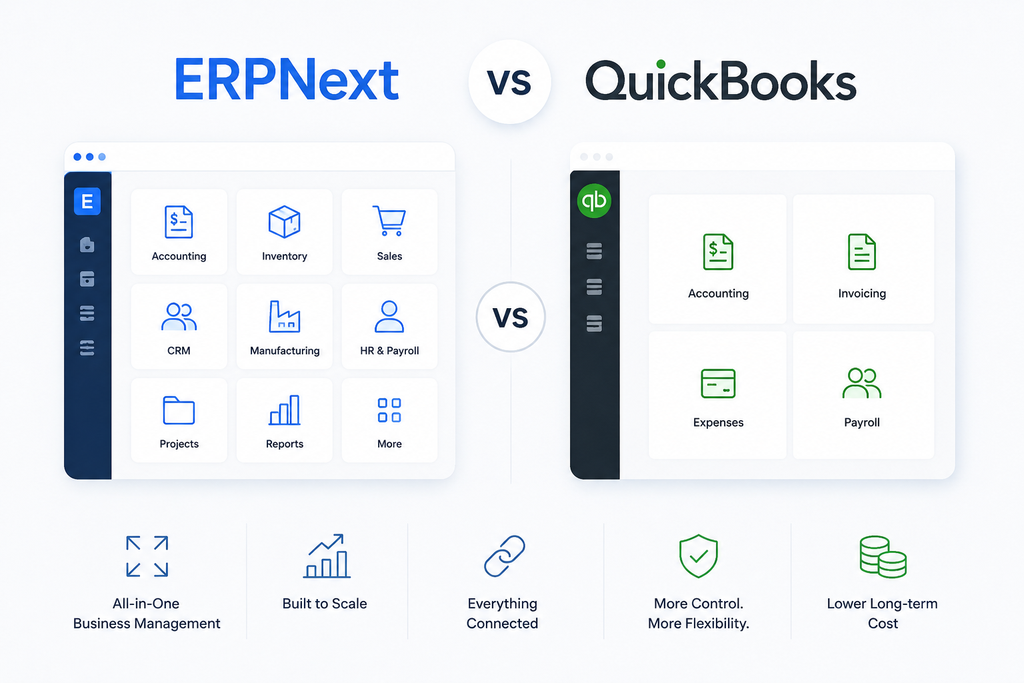
The cost conversation nobody has upfront
QuickBooks pricing looks reasonable at first — a few hundred rupees or dollars a month. But factor in:
- Per-user fees as your team grows
- Add-on costs for inventory, payroll, or time tracking
- Third-party integrations for CRM or project management
- Accountant access fees
By the time a mid-size business stitches together the stack they actually need, the monthly cost is significantly higher than it appeared.
ERPNext has implementation and hosting costs — that's real and worth planning for. A good ERPNext certified implementation partner will help you scope this properly from the start so there are no surprises. The ongoing cost after go-live is typically much lower than a comparable QuickBooks stack.
When QuickBooks is still the right call
Let's be honest here — ERPNext isn't always the answer.
If you're a small service business with under 10 people, no inventory, no manufacturing, and your primary need is invoicing and expense tracking — QuickBooks is faster to set up and easier to hand off to your accountant. The learning curve is lower and the setup time is minimal.
ERPNext requires proper implementation. That's not a weakness — it's the nature of any system that connects your entire operation. But it does mean it's not the right fit if you need something running by end of week with no technical support.
When ERPNext is the clear winner
If any of these are true, ERPNext is likely the better long-term choice:
- You manage inventory across one or more locations
- You have a manufacturing or assembly process
- You need purchase orders, vendor management, or procurement workflows
- You want CRM and sales pipeline in the same system as your financials
- You're planning to scale your team significantly
- You're operating in multiple currencies or across multiple legal entities
- You're tired of paying for integrations between tools that still don't sync properly
The businesses that benefit most from ERPNext are exactly the ones that have already hit QuickBooks' ceiling and are looking for a way out without switching again in two years.
A note on implementation
One thing that often gets overlooked in these comparisons: ERPNext's power comes from how well it's configured for your specific business. A generic setup works, but a properly implemented system — with the right workflows, custom fields, and automations built for your processes — is what actually transforms how a business operates.
That's where working with an experienced team matters. At Tridots Tech, we've been implementing ERPNext for businesses across industries since 2006 and are a Frappe Gold Partner. We've seen what a well-implemented ERPNext does for a growing business, and equally, what a rushed setup leads to. If you're evaluating ERPNext seriously, it's worth seeing how it compares to other ERP options as well — not just QuickBooks.
The bottom line
QuickBooks and ERPNext solve different problems for different stages of business. If you're small and simple, QuickBooks works fine. If you're growing, dealing with inventory or operations beyond basic accounting, or you're tired of managing five tools that should be one — ERPNext is worth a serious look.
The real question isn't which software has a better feature list. It's whether your current tools are keeping up with where your business is going.
If they're not, that's your answer.
Want to explore whether ERPNext is the right fit for your business? Talk to the Tridots Tech team — we'll give you an honest assessment, not a sales pitch.
No comments yet. Login to start a new discussion Start a new discussion