Why Chart of Accounts Design Matters in ERPNext
A well-planned Chart of Accounts helps businesses keep financial records consistent and makes ERPNext reports easier to understand as they grow.
Why Chart of Accounts Design Matters in ERPNext
A finance team can record every transaction correctly and still struggle to answer a simple question: Where exactly is our money going?
Imagine a growing distribution company with three branches. One branch records vehicle-related expenses under “Transport,” another uses “Logistics Expense,” and the head office records similar costs under “Travel & Conveyance.” The transactions may all be valid, but when management wants to understand the company's total logistics spending, the finance team has to manually compare different accounts before arriving at a meaningful number.
This is why the ERPNext Chart of Accounts deserves more attention during an ERP implementation. Businesses often spend considerable time planning sales, purchasing, inventory, manufacturing, and other workflows, while the accounting structure is sometimes treated as a simple setup task. But the way accounts are organized has a direct impact on how easily finance teams can record transactions and how clearly management can understand financial reports.
A good Chart of Accounts does not simply organize accounting entries. It creates a structure that allows financial information to be classified consistently and reported in a way that makes sense for the business.
What Is a Chart of Accounts in ERPNext?
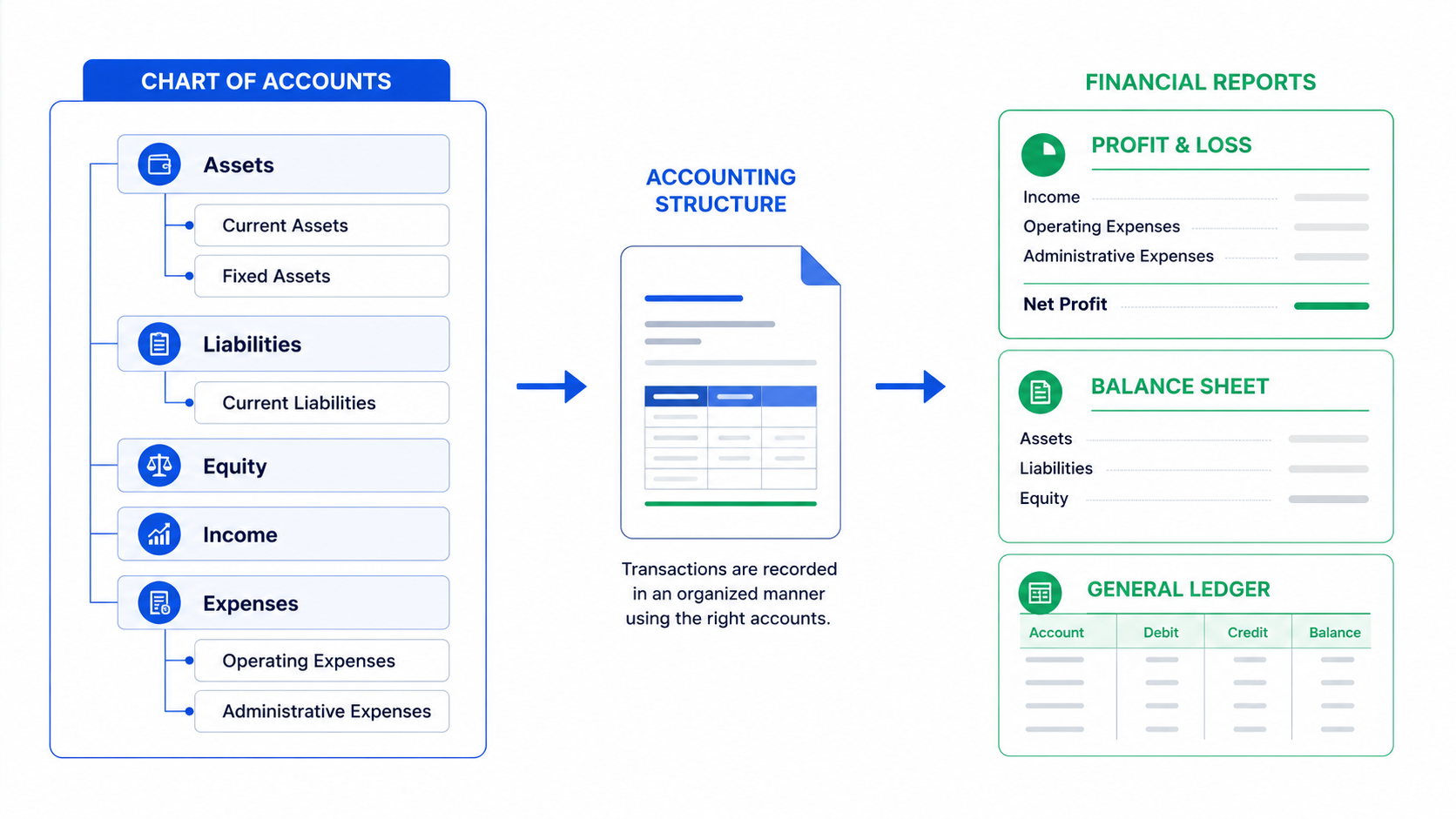
A Chart of Accounts is essentially the framework used to organize a company's accounts. In ERPNext, the Chart of Accounts is presented as a tree structure containing groups and ledger accounts. Groups help organize related accounts, while transactions are posted to ledger accounts. ERPNext also provides a standard Chart of Accounts when a company is created, which can be adjusted according to the company's requirements and applicable regulations.
For example, a business may have broad account groups such as Assets, Liabilities, Equity, Income, and Expenses. Under Expenses, it may have accounts for salaries, rent, travel, utilities, marketing, repairs, and other operating costs. The exact structure depends on the nature of the business and the level of financial detail management needs.
This structure matters because accounting transactions eventually feed into financial reports. Reports such as the General Ledger, Trial Balance, Profit and Loss Statement, and Balance Sheet rely on the underlying accounting entries. If the accounts are organized logically, the resulting information is much easier to understand and analyse.
In other words, the Chart of Accounts is not just an accounting list sitting inside ERPNext. It forms part of the foundation on which the company's financial reporting is built.
Why Chart of Accounts Design Matters in ERPNext
One of the biggest advantages of a well-planned Chart of Accounts is clearer financial reporting. A report is useful only when the people reading it can understand what the numbers actually represent.
Consider a manufacturing company that records factory electricity, office electricity, and warehouse electricity under one broad “Electricity Expense” account. The total expense may be accurate, but management cannot immediately understand how much of that cost is associated with different parts of the business. If those distinctions matter to management, the accounting structure needs to provide an appropriate way to analyse them.
A well-designed Chart of Accounts in ERPNext also encourages consistency. When accountants and finance users have clearly defined accounts for different types of transactions, they are less likely to create multiple accounts for essentially the same expense. This becomes increasingly important as the finance team grows and more people start entering transactions into the system.
The structure also becomes more important as the company expands. A business that starts with one location and a small finance team may have relatively simple reporting requirements. Once it adds branches, departments, projects, or new business activities, management may need more detailed financial visibility.
This does not necessarily mean creating a separate account for every possible category. ERPNext also provides tools such as Cost Centers and Accounting Dimensions that can be used to analyse financial information from different perspectives.
The important point is to decide what the Chart of Accounts should represent and what information should be handled through other accounting structures.
What Happens When the Chart of Accounts Is Poorly Structured?
A poorly structured Chart of Accounts does not always create an immediate problem. In the beginning, users may simply create a new account whenever they encounter an expense that does not appear to have an obvious place. Over time, however, this can lead to duplicate or overlapping accounts.
For example, a company might end up with “Office Maintenance,” “Office Repairs,” “Repairs & Maintenance,” and “Building Maintenance.” Each account may have been created for a reasonable reason at the time, but together they make the overall picture less clear. When management asks for total maintenance costs, the finance team may need to review several accounts instead of getting a straightforward view.
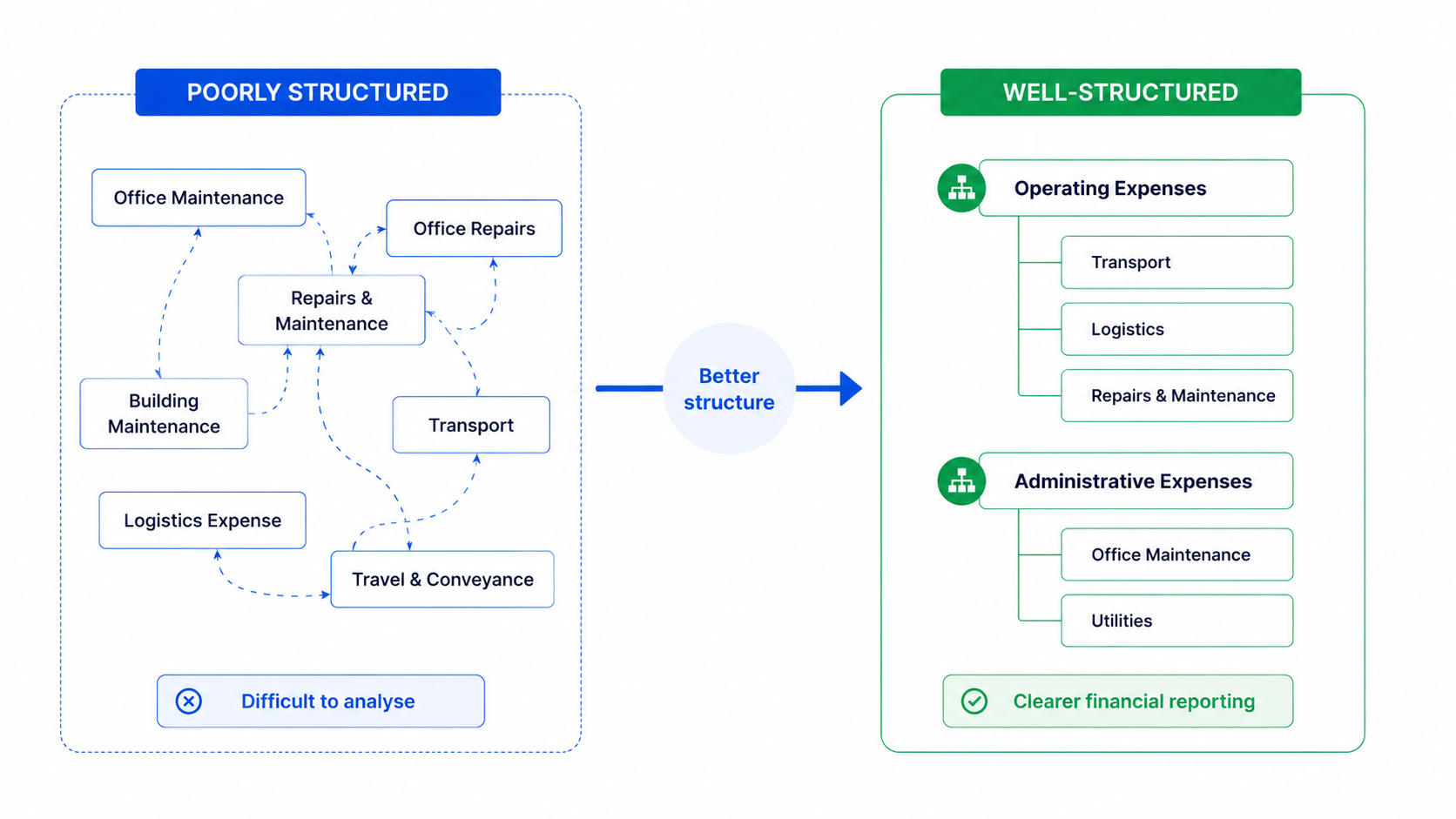
Inconsistent account naming can create a similar problem. Imagine two branches recording the same type of expense using different account names. The accounting entries may still be valid, but comparing financial performance across locations becomes more difficult.
Another issue is creating an accounting structure based only on today's business. A company may have a simple structure when it starts, but later expand into multiple branches or business lines. If the original Chart of Accounts was not planned with reasonable future requirements in mind, the business may eventually need to review and reorganize it.
The solution is not to create hundreds of accounts from the beginning. In fact, an unnecessarily large Chart of Accounts can create its own problems. The objective should be a structure that is detailed enough to provide useful information but simple enough for the finance team to use consistently.
How Should Businesses Plan Their Chart of Accounts Before ERPNext Implementation?
The best time to think about the accounting structure is before the ERPNext accounting setup is finalized. Instead of immediately copying the existing accounts from an old accounting system, businesses should first review what they actually use and what information they need from their financial reports.
Start by reviewing the existing Chart of Accounts. Look for duplicate accounts, accounts that are no longer used, inconsistent naming, and categories that are too broad or unnecessarily detailed. At the same time, identify the financial reports management regularly depends on and the information those reports need to provide.
For example, if management regularly reviews marketing expenses by business unit, the implementation team should understand that requirement before deciding how the accounting structure will be configured. Similarly, if a company operates multiple branches, the team should determine whether the required analysis belongs in the Chart of Accounts, Cost Centers, Accounting Dimensions, or another appropriate structure.
This is also where the finance team needs to be involved in the ERPNext implementation process. The implementation team may understand the software, but the finance team understands how the business records transactions and what information management needs.
Bringing both perspectives together can help create an accounting structure that is practical rather than unnecessarily complicated.
A Practical Example: Structuring Accounts for a Growing Business
Consider a distribution company that operates from Chennai, Coimbatore, and Bengaluru. When the business was smaller, it recorded expenses under broad categories such as Rent, Salaries, Travel, Transport, and Marketing.
After expanding, management wants to compare expenses across locations. One option would be to create separate accounts such as “Chennai Rent,” “Coimbatore Rent,” and “Bengaluru Rent,” followed by separate accounts for travel, transport, marketing, and every other expense category.
That approach can quickly make the Chart of Accounts difficult to manage.
Instead, the business can keep its accounts focused on the nature of the expense while using suitable Cost Centers or Accounting Dimensions where appropriate for additional analysis. ERPNext supports accounting dimensions that can be used with transactions and financial reports, allowing businesses to analyse financial information without necessarily creating a separate ledger account for every reporting requirement.
The exact approach will depend on the company's accounting and reporting needs. The broader principle is simple: do not make the Chart of Accounts carry every reporting requirement by itself.
A good accounting structure separates the different questions management wants to answer. The Chart of Accounts can explain what the transaction is, while other accounting structures can provide additional context where required.
Should You Customize the Chart of Accounts for Your Business?
There is no universal Chart of Accounts that works equally well for every business. A manufacturing company may need a different structure from a software company, retailer, construction company, or professional services firm.
ERPNext provides a standard Chart of Accounts, but businesses can adapt their accounting structure according to their requirements. The important thing is not to copy another company's structure simply because it appears to work for them.
Before making changes, consider the nature of the business, its size, reporting requirements, branch structure, regulatory requirements, and future plans. The accounts should provide enough detail for useful financial analysis without forcing users to choose between dozens of nearly identical options.
A common mistake is assuming that a more detailed Chart of Accounts is automatically better. It isn't. If users cannot easily understand which account to select for a transaction, additional detail may actually make daily accounting more difficult.
The better question is: Does this account structure help the business understand its finances?
How the Chart of Accounts Supports Better ERPNext Reporting
The relationship between the Chart of Accounts and financial reporting is straightforward. Transactions are recorded against accounts, and those accounting entries contribute to the financial reports generated by ERPNext.
The General Ledger provides detailed accounting entries, while the Trial Balance helps review account balances. The Profit and Loss Statement summarizes income and expenses for a selected period, and the Balance Sheet presents the company's assets, liabilities, and equity.
This means the quality of the underlying accounting structure influences how useful those reports are for analysis.
For example, if several unrelated operating expenses are grouped into one broad account, management may see the total expense but not have enough detail to understand what is driving it. On the other hand, if every minor expense has its own account, the report may contain too much detail and become difficult to read.
The right balance depends on the business. The purpose of the Chart of Accounts is not to make financial reports as detailed as possible. It is to make them meaningful and useful.
Common Chart of Accounts Mistakes to Avoid
One common mistake is creating a new account for every small transaction. Before creating a new account, businesses should check whether an existing account already serves the same purpose.
Another mistake is inconsistent naming. A simple and logical naming convention can make it easier for finance users to understand which account should be used.
Duplicate accounts are another issue, especially when different teams or branches create accounts independently. Regular review of the Chart of Accounts can help identify unnecessary duplication.
Businesses should also avoid designing the entire structure around today's requirements. The company may not need a complex structure immediately, but it is worth considering how future branches, products, services, or reporting requirements could affect the accounting setup.
Finally, businesses should avoid using the Chart of Accounts to solve every reporting requirement. Cost Centers and Accounting Dimensions may be more appropriate for analysing financial information by departments, projects, branches, or other business dimensions.
Why Proper Accounting Setup Matters During ERPNext Implementation
An ERPNext implementation is an opportunity to review more than just software configuration. It is also an opportunity to look at whether the company's existing accounting structure still supports the way the business operates.
Before data migration and accounting configuration are finalized, businesses should understand their existing accounts, remove unnecessary duplication, identify reporting requirements, and decide how different types of financial information should be organized.
This is where an experienced ERPNext implementation partner can help connect business requirements with the system setup.
At Tridots Tech, a Frappe Gold Partner and ERPNext implementation partner, accounting configuration should begin with understanding the business and its reporting needs. The objective is not to create a complicated structure simply because ERPNext can accommodate it. It is to build an accounting setup that finance teams can use consistently and management can understand easily.
Conclusion
The ERPNext Chart of Accounts may not be the most visible part of an ERP implementation, but it plays an important role in how financial information is organized and understood.
A well-planned structure can make transaction recording more consistent, financial reports easier to interpret, and future growth easier to manage. At the same time, businesses do not need an unnecessarily complicated list of accounts to achieve better reporting.
The key is to create the right structure for the business.
Before implementing ERPNext, review the existing accounts, remove unnecessary duplication, understand what management needs to see, and decide which information belongs in the Chart of Accounts and which can be handled through Cost Centers or Accounting Dimensions.
When that foundation is planned properly, ERPNext can provide financial information that is not only accurate, but also much easier for the business to understand and use.
No comments yet. Login to start a new discussion Start a new discussion