Why Some Sales Teams Always Know Their Next Move: The ERPNext CRM Advantage
Some sales teams never miss a follow-up or opportunity. Discover how ERPNext CRM helps businesses stay organized, track leads, and close deals with confidence.
Why Do Some Sales Teams Always Know Their Next Move?
There is always that one sales team in every industry — the one that never seems to miss a follow-up, always calls at the right time, and somehow closes deals that others let go cold. Watch them for a week and you will notice something: they are not working harder than everyone else. They just always seem to know what to do next.
That is not a personality trait. That is a system.
And more often than not, the system behind it is a well-configured CRM — specifically, one built into their core business operations rather than sitting as a disconnected tool on the side.
The Problem with "Winging It" in Sales
Most small and mid-sized sales teams start out with a combination of spreadsheets, shared inboxes, sticky notes, and memory. It works — until it does not.
A lead comes in from the website. Someone logs it in a sheet. A follow-up is sent three days later. Then the salesperson goes on leave, and the lead sits there unanswered for a week. By the time someone picks it up again, the prospect has already signed with a competitor.
This is not a people problem. This is a process problem.
When your lead tracking, communication history, quotations, and deal status all live in different places, things fall through. Not because your team is careless — but because no single person can hold all of that in their head reliably, especially when managing twenty or thirty active prospects at once.
What a CRM Actually Does (Beyond Storing Contacts)
A lot of people think a CRM is just a fancy address book. You store names, numbers, company details, and maybe some notes. That is the surface level.
A proper CRM — like the one built into ERPNext — tracks the entire lifecycle of a customer relationship. From the first time someone fills out a form on your website, to the moment they become a paying customer, to every interaction that happens after.
Here is what that looks like in practice:
Lead Capture and Assignment
When a new inquiry comes in, ERPNext CRM can automatically log it, assign it to the right salesperson based on territory or product type, and trigger a follow-up task. The salesperson does not need to check a shared inbox every hour.
Pipeline visibility
Every deal sits in a clear stage: new, contacted, qualified, proposal sent, negotiating, won, or lost. The sales manager can look at the entire pipeline in one view and immediately see where things stand — no status calls, no chasing people for updates.
Activity tracking
Every call, email, and meeting gets logged against the lead or opportunity. When someone on the team picks up a prospect that a colleague was handling, they know exactly what was discussed, what was promised, and what the next step is.
Follow-up scheduling
ERPNext CRM lets you set tasks and reminders tied to specific leads. So instead of relying on memory or calendar notes, the system itself tells you: "Call Ramesh at 10 AM tomorrow — you said you would check back after he reviews the proposal."
Integration with quotes and orders
Because ERPNext CRM is part of a full ERP system, a salesperson can generate a quotation directly from within the CRM module. When the deal closes, it flows into an actual sales order without anyone re-entering data.
The Real Reason Some Sales Teams Are Always Ahead
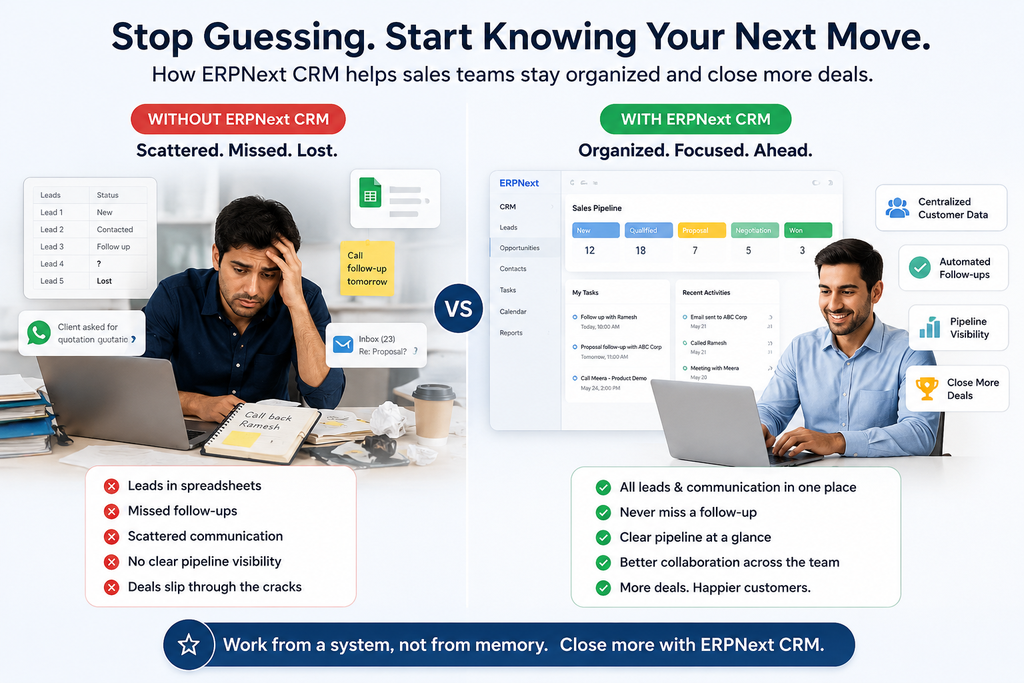
It comes down to one thing: they work from a system, not from memory.
When your CRM is properly set up, the next move is never a question. You open your dashboard in the morning, and it shows you exactly which leads need attention today — the ones you have not contacted in five days, the ones where a proposal is pending, the ones that have a scheduled call.
You are not spending the first hour of your day figuring out what to do. You are already doing it.
This is especially important in B2B sales, where deals take weeks or months and involve multiple conversations. The ability to pick up exactly where you left off — even after a weekend or a holiday — is what separates teams that close from teams that almost close.
ERPNext CRM: Practical for Real Businesses
A lot of CRM tools in the market are built for large enterprises with dedicated sales ops teams. They are powerful, but they come with long setup times, high licensing costs, and complexity that most growing businesses cannot justify.
ERPNext CRM is different. It is open-source, which means there are no per-user licensing fees that scale uncomfortably as your team grows. It is also deeply integrated with the rest of ERPNext — your accounting, inventory, procurement, and HR modules all share the same data layer.
For a business that is trying to get a clear picture of customer acquisition cost, or wants to see how a delayed shipment is affecting customer satisfaction, that kind of integration is genuinely useful. You are not exporting data from your CRM into your ERP every week and wondering why the numbers do not match.
Some specific features in ERPNext CRM that sales teams find practical:
Lead scoring
You can define criteria that automatically score leads based on source, company size, or engagement level, so your team focuses effort where it is most likely to convert.
Email integration
Emails sent and received in your inbox can be linked to the corresponding CRM record, so the communication history is always complete.
Custom fields and workflows
Every business sells differently. ERPNext allows you to customize the CRM to match your actual sales process, not force your process to fit a rigid template.
Reports and dashboards
Monthly lead reports, conversion rates by source, salesperson performance, pipeline value by stage — all of this is available without building separate reports in spreadsheets.
Setting Up for Success: It Is Not About the Tool Alone
A CRM is only as useful as the discipline behind it. If half the team logs activities and half does not, the pipeline view is unreliable. If follow-up tasks are created but never completed, the system becomes a graveyard of missed opportunities.
The businesses that get the most out of ERPNext CRM are the ones that treat it as the single source of truth for all customer-related activity. That means:
Logging every interaction, even brief ones. Setting realistic follow-up dates and actually following up. Keeping deal stages accurate so the pipeline reflects reality. Using the reports to have honest conversations about what is working and what is not.
It takes a few weeks to build the habit. But once it is there, the compounding effect is significant. Your pipeline becomes reliable. Your conversion rates become trackable. And your team stops losing deals simply because someone forgot to follow up.
A Note on Implementation
If you are considering ERPNext CRM for your team, the implementation partner you choose matters as much as the tool itself. The configuration decisions — how your lead stages are defined, how leads are assigned, what fields are tracked, how your quotation workflow is set up — will determine how useful the system actually is day to day.
At Tridots Tech, we work with businesses across manufacturing, distribution, services, and retail to implement ERPNext in a way that fits how they actually operate. Not a generic setup that looks good in a demo and causes headaches in week three.
If you are currently relying on spreadsheets or a disconnected CRM and want to understand what a more structured setup would look like for your business, we are happy to walk through it with you.
Closing Thought
Sales teams that always know their next move are not clairvoyant. They have built a system where the next move is visible, assigned, and tracked. The tool that makes that possible — when configured well — is a CRM that is part of your business operations, not an afterthought sitting alongside them.
ERPNext CRM is one of the more practical options available for growing businesses that want that kind of visibility without the complexity and cost that usually comes with it.
The question is not whether your team needs a system like this. The question is how long you can afford to go without one.
Tridots Tech is an ERPNext implementation partner helping businesses build systems that support growth. Get in touch to learn how we can help set up ERPNext CRM for your sales team.
No comments yet. Login to start a new discussion Start a new discussion