The Hidden Cost of Manual HR Processes for Growing Businesses
Attendance issues, payroll delays, and scattered employee records consume valuable HR time. Discover how growing businesses can reduce manual work with Frappe HR.
The Hidden Cost of Manual HR Processes for Growing Businesses
If you're a business owner or HR manager, you've probably seen it happen every week.
A payroll deadline approaches, attendance records need verification, leave requests are waiting for approval, and someone is searching for an employee document that should have been easy to find.
None of these tasks are unusual. They are part of everyday HR operations. The problem is that many organizations still rely on spreadsheets, email chains, and disconnected systems to manage them.
As employee numbers grow, these routine activities demand more time and attention. HR teams often spend hours maintaining records, preparing reports, and correcting data instead of focusing on employee development, workforce planning, and organizational growth.
The issue is rarely a lack of effort. More often, it comes down to processes that were never designed to handle a growing workforce.
This is where Frappe HR can help. Before discussing the platform itself, it is important to understand why so many HR teams continue to struggle with repetitive administrative work.
Where HR Teams Spend Their Time Every Week
Most HR professionals begin their day with a list of pending requests.
An employee needs a leave balance update.
A manager wants attendance records for the previous month.
Payroll preparation is approaching.
A new employee needs to be added to multiple systems.
Management wants a workforce report before the end of the day.
Each request may only take a few minutes. However, when repeated across dozens or hundreds of employees, these tasks consume a significant portion of the workweek.
Many businesses continue to manage employee information using spreadsheets, shared folders, emails, and standalone applications. While these methods may work for a small team, they become increasingly difficult to maintain as the organization grows.
The result is simple: HR teams spend more time managing information than using it.
What Causes Repetitive HR Administration?
Disconnected Employee Records
Employee information is often stored across multiple locations.
Personal details may exist in one spreadsheet. Attendance records may be stored elsewhere. Payroll information could be managed in a separate application.
When information is scattered, HR teams spend valuable time searching, updating, and verifying records.
Even small changes, such as updating an employee's contact information, may require modifications in multiple places.
Manual Attendance Management
Attendance tracking remains one of the most time-consuming HR activities.
Missing check-ins, incorrect attendance entries, shift adjustments, and overtime calculations frequently require manual review.
When attendance data needs constant correction, HR teams lose hours every month managing exceptions rather than focusing on higher-value work.
Email-Based Leave Approvals
Many organizations still process leave requests through email.
An employee submits a request.
The manager misses the email.
A follow-up message is sent.
HR gets involved.
What should take minutes can stretch across several days.
Payroll Preparation Challenges
Payroll depends on accurate attendance, leave balances, employee information, and compensation details.
When this information comes from different sources, payroll preparation becomes more complicated than it should be.
Even minor inconsistencies can create delays and additional verification work.
Reporting Delays
Business leaders often require workforce data to make informed decisions.
Questions such as:
- What is the current headcount?
- Which departments have the highest absenteeism?
- How many employees are on leave this month?
- What are the attendance trends?
When information is maintained across multiple systems, generating reports becomes a manual process that takes time.
The Business Impact of Manual HR Processes
Many business owners view HR administration as an internal function.
However, the effects of manual HR processes extend across the entire organization.
Increased Administrative Workload
As employee numbers increase, administrative tasks grow at the same pace.
Without better systems, HR teams often find themselves spending more time maintaining records than supporting employees.
Payroll Delays
Payroll delays can affect employee trust and satisfaction.
When payroll preparation requires extensive manual verification, meeting deadlines becomes more difficult.
Data Inconsistencies
Multiple spreadsheets and disconnected systems increase the risk of duplicate records and outdated information.
Accurate workforce data becomes harder to maintain.
Limited Workforce Visibility
Business leaders need access to reliable workforce information.
Without centralized data, understanding attendance trends, workforce performance, and staffing requirements becomes challenging.
Slower Decision-Making
When reports take days to prepare, decisions are often made using outdated information.
This affects planning, hiring, workforce allocation, and overall business operations.
How Frappe HR Helps Reduce Manual HR Work
At this stage, many businesses begin looking for a better way to manage HR operations.
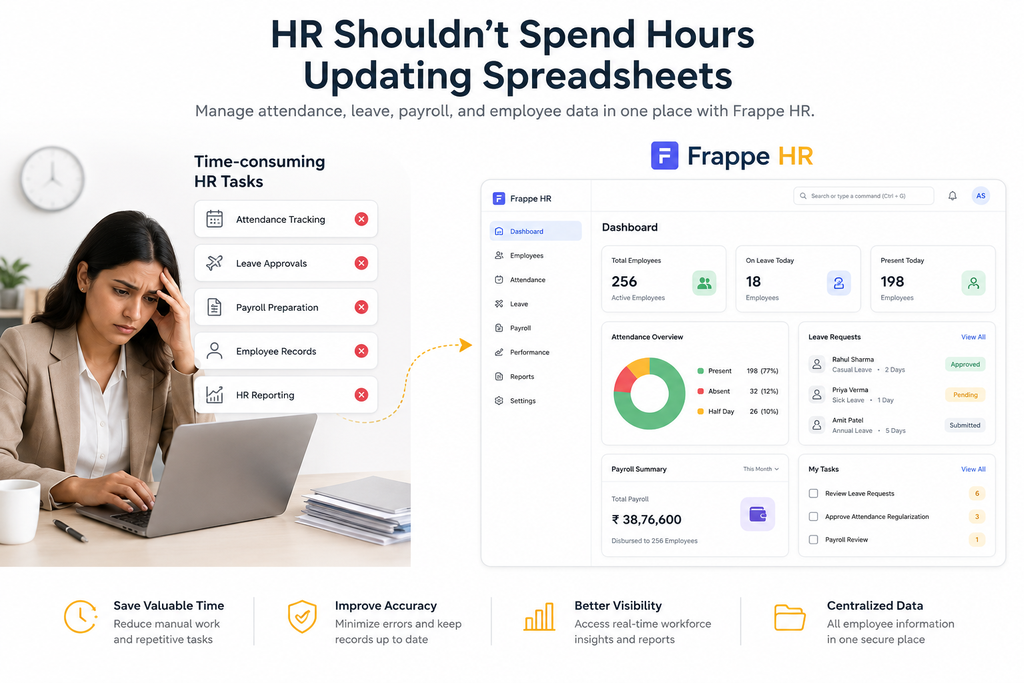
Frappe HR provides a centralized approach to workforce management by bringing employee records, attendance, leave management, payroll, and reporting into a single platform.
Instead of maintaining multiple spreadsheets and separate systems, HR teams can access workforce information from one place.
This reduces the amount of time spent collecting, verifying, and updating information.
More importantly, it helps HR teams focus on employees rather than administration.
Many organizations searching for ERPNext HRMS solutions are now adopting Frappe HR because it offers dedicated workforce management capabilities while remaining flexible enough to support growing businesses.
Key Frappe HR Capabilities
Employee Management
Employee records are maintained in a centralized database, making information easier to access and update.
HR teams no longer need to search through multiple files to find critical employee information.
Attendance Management
Frappe HR helps businesses maintain accurate attendance records and reduce manual tracking efforts.
Attendance information becomes easier to review, manage, and report on.
Leave Management
Employees can submit leave requests digitally, while managers can review and approve requests through predefined workflows.
This reduces follow-ups and improves visibility into leave balances.
Payroll Management
Payroll calculations can be generated using employee records, attendance information, and predefined payroll structures.
This helps reduce manual payroll preparation efforts.
Employee Self-Service
Employees can access relevant information without contacting HR for every request.
This reduces administrative workload while improving employee experience.
HR Reporting and Analytics
HR teams and management can access workforce information more quickly, helping them make informed decisions based on current data.
Real-World Example: How Ovation WPS Improved Workforce Management
A practical example of these challenges can be seen in Ovation WPS.
Before implementing Frappe HRMS, the company managed employee information across disconnected systems.
Attendance tracking, employee record management, and reporting required significant manual effort.
HR teams lacked a centralized platform to monitor workforce activities and employee performance.
Reporting processes were time-consuming, limiting access to workforce insights when they were needed most.
To address these challenges, Tridots Tech implemented Frappe HR.
The implementation included:
- Centralized employee database
- Attendance and leave management
- Payroll processing
- Employee performance tracking
- HR reporting and workforce analytics
As a result, Ovation WPS reduced administrative effort, improved workforce visibility, gained faster access to workforce insights, improved reporting accuracy, and established a scalable HR foundation for future growth.
Tridots Tech helped Ovation WPS centralize its workforce management processes using Frappe HRMS. By automating attendance tracking, employee management, payroll, and HR reporting, the company improved workforce visibility, reduced administrative effort, and established a scalable HR system that supports long-term business growth.
What to Consider Before Implementing Frappe HR
Review Existing HR Processes
Before implementing any HRMS platform, businesses should understand how employee records, attendance, leave approvals, payroll, and reporting are currently managed.
This helps identify inefficiencies and areas that need improvement.
Define Payroll Requirements
Every organization has unique payroll structures, allowances, deductions, and compliance requirements.
Understanding these requirements early helps ensure a smoother implementation process.
Plan for Future Growth
The workforce may double in the coming years.
An HR system should support growth without requiring major process changes later.
Focus on User Adoption
Technology alone is not enough.
Employees, managers, and HR teams need proper training and clear processes to make the most of the system.
Why Choose Tridots Tech for Frappe HR Implementation
Implementing HR software involves more than configuring a platform.
It requires understanding workforce processes, business objectives, reporting requirements, and operational challenges.
As a Certified Frappe Gold Partner, Tridots Tech helps businesses implement Frappe HR based on their specific workforce management needs.
Our team works closely with organizations to configure employee management, attendance tracking, leave workflows, payroll processes, reporting requirements, and user access controls.
The goal is not simply to deploy software, but to help businesses reduce administrative effort and gain better visibility into workforce operations.
Conclusion
If your HR team spends hours every week managing attendance corrections, processing leave requests, preparing payroll data, updating employee records, and compiling reports, the issue may not be the workload itself.
The issue may be the way those processes are being managed.
As organizations grow, manual HR administration becomes increasingly difficult to maintain.
Frappe HR helps businesses centralize workforce management, reduce repetitive administrative tasks, improve reporting, and gain better visibility into employee operations.
If you are evaluating HR software for your organization, Tridots Tech can help you assess your requirements and implement Frappe HR based on your business needs.
As a Certified Frappe Gold Partner, Tridots Tech helps businesses build HR systems that support both current operations and future growth.
Ready to simplify HR operations?
Contact Tridots Tech to explore how Frappe HR can help your organization spend less time on administration and more time supporting its people.
No comments yet. Login to start a new discussion Start a new discussion