7 Red Flags to Watch Before Choosing an ERPNext Implementation Partner
You've shortlisted ERPNext. Now, before choosing an implementation partner, watch for these 7 red flags that could affect your project's success.
7 Red Flags to Watch Before Choosing an ERPNext Implementation Partner
You've evaluated ERPNext, shortlisted the modules you need, and now you're comparing implementation partners. This is where an important question comes up: how do you know whether the partner you're talking to is actually the right fit for your business?
The software is only one part of an ERP project. How well the partner understands your business, how they approach configuration and customization, how they handle your existing data, how they prepare your team, and what support they provide after go-live can all affect how the implementation works in practice.
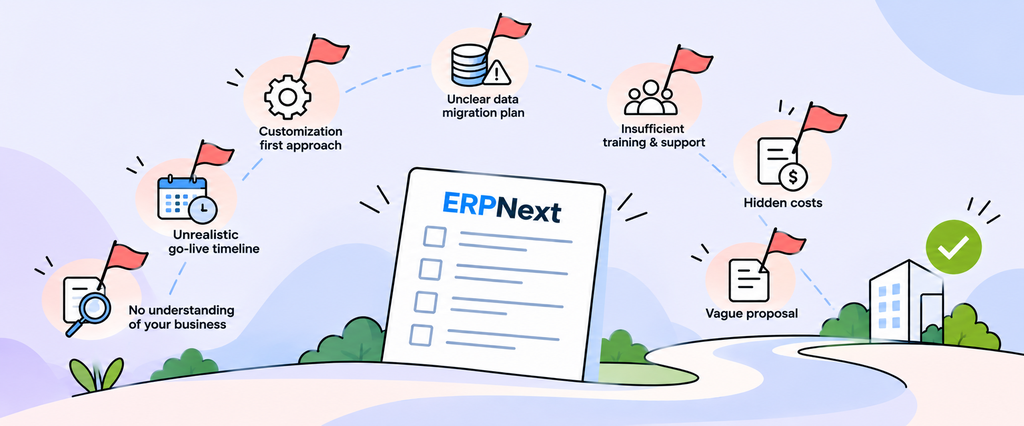
A good ERPNext implementation partner should do more than demonstrate features and provide a quotation. They should understand how your business operates, identify what ERPNext can handle through its standard functionality, explain where customization may be necessary, and give you a clear picture of what happens before and after go-live. Here are seven red flags worth watching for before you sign an agreement.
1. They Jump Straight Into ERPNext Features Without Asking About Your Business
If the first meeting is mostly a product demonstration — click here, this module does that, this report shows this — before anyone has asked how your business actually operates, that's worth noticing. An ERPNext implementation should begin by understanding your business requirements rather than simply showing you everything the software can do.
A good implementation discussion should cover your departments, approval processes, current software, reporting requirements, user roles, and the problems you are trying to solve. The partner should understand how information moves through your business and where delays, manual work, or duplicate processes currently exist. Only after understanding these areas can they start mapping your requirements to ERPNext.
For example, a distribution company may have specific requirements around partial deliveries, backorders, pricing, and stock availability. A manufacturing company may need quality checks at particular stages of production, while a service company may focus more on projects, timesheets, billing, and approvals. These requirements will not necessarily come out of a standard ERPNext demo. They come from asking the right questions.
Seeing ERPNext's accounting, buying, selling, stock, manufacturing, projects, or other modules in action is useful when evaluating the software. However, a demonstration alone does not tell you whether the proposed implementation will fit the way your business works. The first conversation should be about your business, not just about the software.
2. They Give You a Go-Live Date Before They've Really Looked at Your Requirements
Be cautious if a partner gives you a firm go-live date during the first conversation, before they have properly understood the scope of your ERPNext implementation. A quick timeline may sound attractive, especially when you want to get the new system running quickly, but an implementation involves several activities that need to be assessed before a realistic schedule can be prepared.
The timeline can depend on the ERPNext modules required, number of users, existing business processes, customization, integrations, data migration, testing, training, and approval workflows. Even two companies using the same ERPNext modules can have very different implementation requirements because their processes, data, and reporting needs may be different.
For example, imagine a company being told, "We'll have you live in three weeks," before the partner has reviewed its item master, existing accounting data, approval workflows, integrations, or reporting requirements. That date may be an estimate rather than a properly assessed project timeline. A more useful discussion is one where the partner explains what needs to be reviewed first and how the implementation milestones will be determined.
This does not mean a partner should never provide an estimated timeline early in the discussion. The important point is whether the estimate is based on an understanding of the project scope. A realistic ERPNext implementation plan should have a reason behind its timeline.
3. They Want to Jump Into Customization Before Exploring What ERPNext Already Does
ERPNext already provides functionality across areas such as accounting, buying, selling, stock, manufacturing, projects, assets, and other business operations. Because of this, an implementation partner should first understand what can be handled through standard ERPNext functionality and configuration before recommending custom development.
There is a difference between configuring ERPNext, adding custom fields or workflows, writing custom scripts, developing a custom Frappe application, and integrating another system. Each approach has different implications for development, testing, maintenance, and future changes. A good partner should explain these differences in business terms rather than simply presenting customization as the answer to every requirement.
When Customization Actually Makes Sense
Customization itself is not a problem. Some businesses have genuine requirements that standard ERPNext cannot reasonably address, and custom development can be appropriate in those situations. The concern is when customization becomes the default approach without first checking whether the requirement can be handled through existing ERPNext functionality or configuration.
Unnecessary customization can add maintenance work and may make future ERPNext upgrades more involved. Before approving custom development, ask whether standard ERPNext can handle the requirement, whether a configuration or workflow can solve it, and why custom development is actually necessary.
A good ERPNext partner should be able to explain the reasoning behind the recommendation, not simply propose development. The goal should be to build an ERPNext setup that meets the business requirement without adding development work that the business does not actually need.
4. They Don't Have a Clear Plan for Your ERPNext Data Migration
"We'll migrate your data" sounds reassuring, but it doesn't actually tell you much. Data migration is one of the areas where businesses should ask for more detail because the quality of the information brought into ERPNext can directly affect how users work with the new system.
A proper ERPNext data migration plan should explain what is moving, how the data will be prepared, how it will be mapped into ERPNext, how the migrated records will be validated, and who is responsible for each stage. Depending on the project, this may include customer and supplier records, item masters, opening balances, and selected historical transactions. The exact migration scope should be agreed before the work begins.
What Should Be Covered in Data Migration?
For example, a business moving from Tally or another ERP system may have years of customer records, supplier information, item data, accounting information, and transactions. Some of that data may need to be reviewed or cleaned before it is migrated. Fields from the existing system may also need to be mapped to the appropriate ERPNext fields, followed by validation to make sure the migrated information is correct.
The partner should also make it clear which data the business needs to provide, what preparation is expected from the internal team, and how the migrated information will be checked before users start working with it.
If a partner's entire migration explanation is simply "we'll take care of it," ask for more detail. You should understand what will be migrated, what your team needs to provide, how validation will happen, and who is responsible for resolving data issues. Data migration is a project activity, not just a file upload.
5. Training Feels Like a One-Day Walkthrough
If ERPNext training consists of one afternoon of "here's the dashboard, here's where you click," that's closer to a product tour than proper user training. ERP systems affect daily processes, so users need more than a basic introduction to where different screens are located.
ERPNext training works better when it is connected to the roles and transactions users actually handle. Finance users may need to work through accounting processes, while purchase teams need to understand buying transactions and approvals. Sales teams may need to work through selling processes, warehouse users need to understand stock transactions, and production teams need training around the manufacturing workflows relevant to their responsibilities.
Training Should Reflect Actual Business Workflows
The training approach can also include realistic business scenarios and opportunities for users to ask questions before the system goes live. This helps teams understand not just where to click, but why a particular transaction or workflow is being used.
For example, instead of simply showing a sales user where to create a Sales Order, training can walk through the type of sales process that user will actually follow. The same principle can be applied to purchasing, stock, accounting, manufacturing, projects, and other areas included in the implementation.
There's a real difference between showing someone where the buttons are and preparing them to use ERPNext in their daily work. When evaluating an implementation partner, ask what training is included, who will receive it, and how users will be prepared before go-live.
6. They Can't Clearly Explain What Happens After Go-Live
Go-live is not necessarily the end of the ERPNext project. It is the point at which the system becomes part of the company's day-to-day operations, and users may begin discovering questions or issues that were not obvious during implementation and testing.
Before signing an agreement, ask what happens after launch. How do you report an issue? Who handles bugs? How are configuration changes requested? What happens when users need help? How are ERPNext upgrades handled? Who is responsible for backups, deployment, or hosting-related concerns if those services are included in the engagement?
Understand the Support Arrangement Before Signing
The exact support model can differ between ERPNext implementation partners, so there is no single approach that every company must follow. What matters is that the responsibilities are clearly explained and documented before the project begins.
If a partner says you will "figure it out later," ask for the post-go-live support process in writing. Understand what support is included, how issues are communicated, what falls outside the agreed scope, and what happens when your business needs changes after implementation.
Knowing the support arrangement before go-live is much easier than trying to define it after your team is already depending on ERPNext every day. Post-go-live support should be part of the implementation conversation from the beginning.
7. Their Proposal Sounds Good but Says Very Little
A proposal that simply says "complete ERPNext implementation" without explaining what that actually includes does not give you enough information to compare implementation partners properly. A lower or higher price on its own does not tell you whether two proposals are offering the same scope.
A clear ERPNext implementation proposal should identify the modules and requirements in scope, planned customization, integrations, data migration, user roles, training, testing and user acceptance, project milestones, responsibilities at go-live, post-go-live support, and commercial terms. Where appropriate, it should also explain what is not included so that both sides have the same understanding of the project.
Look Beyond the Final Price
For example, if a proposal says "ERPNext customization included" without describing what will actually be developed, it becomes difficult to understand the expected deliverables. Similarly, if data migration is mentioned without explaining the migration scope or validation process, an important part of the project remains unclear.
A detailed proposal may take more time to prepare, but it gives both the business and the implementation partner a clearer starting point. It also makes it easier to compare different proposals based on scope and responsibilities rather than looking only at the final price.
Before comparing prices, compare what each proposal actually includes.
What a Good ERPNext Implementation Partner Should Be Able to Explain
Looking for red flags is useful, but it is equally important to understand what a good ERPNext implementation discussion should look like. You should come away from the conversation with a clearer understanding of how the partner plans to approach your business requirements, rather than simply knowing more about ERPNext features.
A potential ERPNext partner should be able to explain how they conduct discovery, which requirements can be handled using standard ERPNext functionality, and where configuration or customization may be required. They should also be able to discuss their approach to data migration, testing, user training, integrations, go-live preparation, and post-go-live support.
How They Conduct Discovery
The partner should be able to explain what information they need from your business before recommending an implementation approach. This may include your existing workflows, departments, approval processes, reports, current software, users, and specific business requirements.
How They Handle Standard ERPNext and Custom Requirements
The partner should be able to explain which requirements can be handled using standard ERPNext functionality and where configuration, customization, or integration may be required. More importantly, they should be able to explain why a particular approach is being recommended.
How They Approach Data Migration and Testing
The partner should be able to explain what data will be migrated, how it will be mapped and validated, and how users will test the system before go-live. A clear testing and user acceptance process gives the business an opportunity to identify issues before ERPNext becomes part of daily operations.
What Happens After Go-Live
The partner should also be able to explain what support looks like after launch, including how users report issues, how agreed changes are handled, and what the process is for ongoing ERPNext support or upgrades.
You do not need every ERPNext partner to follow exactly the same implementation methodology. Different projects have different requirements. What matters is whether the partner can explain its approach clearly, connect it to your business requirements, and define responsibilities and deliverables in a way that both sides understand.
Questions to Ask Before Choosing an ERPNext Implementation Partner
Before your next discussion with an ERPNext implementation company, take a few practical questions with you. These can help you move the conversation beyond a product demonstration and into the actual details of the implementation.
How will you understand our existing business processes before recommending the implementation approach?
Which of our requirements can be handled using standard ERPNext without customization?
Which requirements would actually need customization, and why?
What exactly is included in the ERPNext implementation scope?
How will you handle our existing data, including cleaning, mapping, migration, and validation?
How will testing and user acceptance be managed before go-live?
What kind of ERPNext training will our users receive?
What does post-go-live support look like?
How are ERPNext upgrades handled going forward?
What exactly is included in your proposal, and what is outside the scope?
The answers to these questions can give you a much better basis for comparing proposals than a feature list or a sales presentation alone. They also help you understand what the implementation partner expects from your team and what responsibilities the partner will take on.
Final Thought
Choosing ERPNext is one decision. Choosing the team that will implement it is a separate one, and it deserves the same level of attention. The software can provide the foundation, but the implementation process determines how that software is configured around your actual business requirements.
The way a partner runs discovery, decides between standard ERPNext and customization, handles data migration, prepares users, and supports the system after launch can shape the practical experience of the implementation. That is why it is worth looking beyond demonstrations and pricing when you compare ERPNext implementation partners.
At Tridots Tech, ERPNext implementation starts with understanding the business before deciding what needs to be configured, customized, migrated, or integrated. As a Frappe Gold Partner, Tridots Tech works with businesses on ERPNext implementation, customization, migration, training, and ongoing support.
If you're comparing ERPNext implementation partners, use the questions above in your next discussion. The right conversation should give you a clear picture of what's included, what's required from your team, and what happens after go-live.
No comments yet. Login to start a new discussion Start a new discussion