ERPNext for Retail Businesses: Managing Omnichannel Operations
Explore how ERPNext helps retail businesses manage inventory, sales, and omnichannel operations through one connected system.
How ERPNext Supports Omnichannel Retail Operations
Retail has changed dramatically over the last few years. Customers no longer shop through just one channel. They browse products on websites, compare prices on mobile apps, visit physical stores, place orders through social media, and expect smooth delivery experiences — all at the same time.
For retailers, this creates a major challenge:
How do you manage inventory, sales, customer data, and operations across multiple channels without creating confusion?
This is where ERPNext becomes a powerful solution for modern retail businesses.
At Tridots Tech, we work with businesses that are trying to simplify retail operations while improving customer experience. One common issue we see is disconnected systems — separate tools for billing, stock, online orders, accounting, and customer management. Over time, this creates delays, errors, and operational stress.
ERPNext helps bring everything together into one unified system.
What Is Omnichannel Retail?
Omnichannel retail means selling through multiple connected channels while maintaining a consistent customer experience.
For example:
- A customer checks product availability online
- Visits the store to try the product
- Places the order through mobile
- Receives delivery updates through email or WhatsApp
From the customer's perspective, everything feels connected.
But behind the scenes, retailers often struggle with:
- Inventory mismatches
- Delayed order updates
- Manual stock tracking
- Billing confusion
- Poor coordination between online and offline sales
Managing all this manually becomes difficult as the business grows. That's why many businesses are now looking for retail ERP software that can centralize operations.
How ERPNext Helps Retail Businesses
ERPNext is designed to manage core business operations from a single platform. For retail businesses, this means better visibility, smoother workflows, and fewer operational gaps.
Instead of using multiple disconnected tools, retailers can manage all of the following within one system:
- Inventory
- Point of Sale (POS)
- Accounting
- CRM
- Procurement
- Warehouse operations
- Customer data
- E-commerce integrations
The biggest advantage is that information updates in real time.
- When a product is sold, stock updates automatically.
- When inventory is low, purchase planning becomes easier.
- When customers place online orders, teams can track fulfillment without switching between systems.
This improves both operational efficiency and customer satisfaction.
Centralized Inventory Management
Inventory management is one of the biggest pain points in retail.
A common issue many retailers face is selling products online that are already out of stock in stores. This creates customer frustration and affects trust.
ERPNext helps retailers maintain centralized inventory tracking across:
- Multiple stores
- Warehouses
- Online platforms
- Sales channels
Retail teams can easily:
- Track stock levels
- Monitor fast-moving items
- Manage stock transfers
- Reduce overstocking
- Avoid stockouts
For growing retail businesses, this visibility becomes extremely important.
Smarter Point of Sale (POS)
Retail billing needs to be fast, simple, and reliable.
ERPNext includes a built-in POS system that helps retailers handle:
- In-store billing
- Barcode scanning
- Discounts and pricing
- Multiple payment methods
- Customer purchase tracking
Since the POS is connected with inventory and accounting, retailers no longer need separate manual updates. This reduces errors and saves time for store staff.
Better Customer Experience
Modern customers expect convenience and personalization.
With ERPNext, retailers can maintain customer information in one place, including:
- Purchase history
- Contact details
- Loyalty information
- Communication records
This helps businesses:
- Understand buying behavior
- Run targeted promotions
- Improve customer engagement
- Build long-term customer relationships
For retailers focusing on customer retention, this becomes highly valuable.
Managing Online and Offline Sales Together
Many retail businesses today operate both physical stores and online platforms. Without a connected system, managing orders across channels becomes complicated.
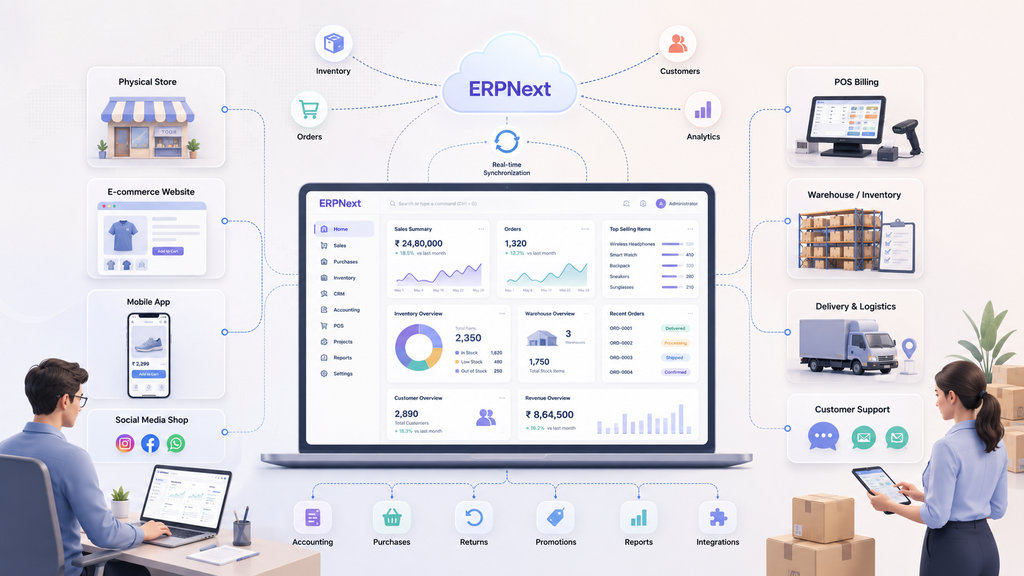
ERPNext helps retailers streamline omnichannel operations by connecting:
- Website orders
- Store sales
- Inventory updates
- Accounting records
- Delivery tracking
This creates better coordination between teams and improves operational transparency. Instead of constantly checking different systems, businesses can access everything from a single dashboard.
Real-Time Reporting for Better Decisions
Retail businesses generate large amounts of data every day. But data is only useful when it helps decision-making.
ERPNext provides real-time reports for:
- Sales performance
- Inventory movement
- Revenue tracking
- Profitability
- Customer trends
- Purchase analytics
This helps business owners make faster and smarter decisions. Instead of relying on assumptions, retailers can use actual operational data to plan inventory, marketing, and growth strategies.
Why Retail Businesses Choose ERPNext
One reason many businesses prefer ERPNext is flexibility.
Different retail businesses operate differently. A fashion retailer, supermarket, electronics store, or distribution business will all have unique workflows. ERPNext allows customization based on business requirements without forcing rigid processes.
Retailers also benefit from:
- Open-source flexibility
- Scalable architecture
- Lower operational complexity
- Integrated modules
- User-friendly interface
For businesses planning long-term digital transformation, ERPNext offers both adaptability and scalability.
How Tridots Tech Supports Retail Businesses
At Tridots Tech, we help retail businesses implement ERPNext based on their actual operational needs.
Our approach focuses on:
- Understanding business workflows
- Simplifying operations
- Reducing manual processes
- Improving visibility across departments
- Supporting long-term scalability
We work with businesses across industries to implement ERPNext solutions that are practical, efficient, and aligned with day-to-day operations. From implementation and customization to automation and support, our team helps businesses make ERP adoption smoother and more effective.
Final Thoughts
Retail businesses today need more than basic billing software. They need connected systems that can manage operations across multiple channels while keeping customer experience smooth and consistent.
ERPNext helps retailers bring inventory, sales, accounting, customer management, and operations together into one unified platform.
As omnichannel retail continues to grow, businesses that invest in connected and scalable systems will be better prepared for future growth. For retailers looking to simplify operations and improve visibility across channels, ERPNext can be a strong foundation for digital transformation.
No comments yet. Login to start a new discussion Start a new discussion