Financial Reporting Taking Too Long? Here’s How ERPNext Simplifies Accounting
Manual accounting slowing your business down? Discover how ERPNext simplifies financial reporting with real-time visibility and automation.
For many businesses, financial reporting is still one of the most time-consuming parts of daily operations.
Finance teams often spend hours collecting spreadsheets, matching invoices, verifying entries, checking balances, and preparing reports manually. By the time reports are ready, decision-makers are already waiting for updated numbers.
As businesses grow, accounting becomes more complex. Managing multiple transactions, vendors, taxes, payroll, inventory costs, and financial approvals manually can quickly slow down operations and increase the chances of reporting errors.
This is where modern ERP software like ERPNext is making a real difference.
ERPNext helps businesses simplify accounting processes, automate financial workflows, and generate real-time financial reports from a single platform. Instead of spending days preparing reports manually, finance teams can access accurate business data instantly and make faster decisions with confidence.
At Tridots Tech, we’ve worked with businesses across manufacturing, retail, distribution, services, and automotive industries to help streamline accounting and financial operations through ERPNext implementation and automation.
In this blog, let’s explore why financial reporting becomes difficult for growing businesses and how ERPNext helps simplify accounting management.
Why Financial Reporting Becomes Difficult
As businesses expand, financial data starts coming from multiple departments and systems.
Sales data may be stored in one software. Inventory details might sit in another system. Payroll could be handled separately. Expenses may still be tracked manually through spreadsheets or emails.
When information is disconnected, finance teams spend more time gathering data than actually analyzing it.
Some of the most common accounting challenges businesses face include:
- Delayed financial reporting
- Manual data entry errors
- Difficulty tracking expenses
- Lack of real-time financial visibility
- Complex tax calculations
- Inventory and accounting mismatches
- Duplicate entries
- Slow approval workflows
- Challenges managing multi-branch finances
These issues not only affect finance teams but also impact overall business decision-making.
When reports take too long, businesses lose visibility into cash flow, profitability, and operational performance.
How ERPNext Simplifies Accounting
ERPNext is designed to centralize business operations, including accounting, inventory, payroll, procurement, sales, and reporting.
Instead of managing finance across disconnected tools, businesses can manage everything from one integrated ERP system.
Here’s how ERPNext helps simplify accounting and financial reporting.
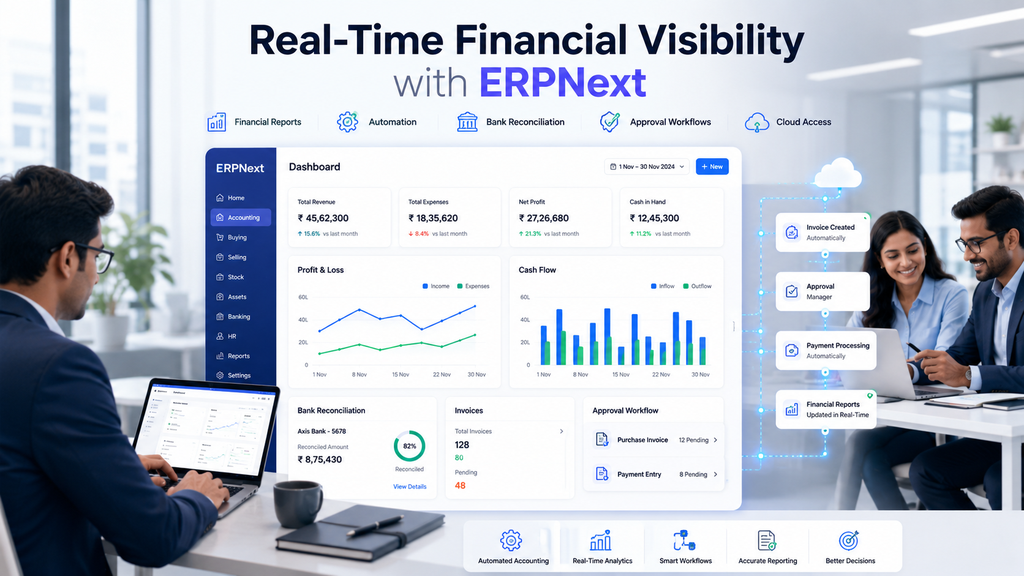
Real-Time Financial Reporting
One of the biggest advantages of ERPNext accounting software is real-time reporting.
As transactions happen across the business, financial data automatically updates inside the system. This means finance teams no longer need to manually consolidate reports from different departments.
Businesses can instantly access:
- Profit and Loss statements
- Balance Sheets
- Cash Flow reports
- Accounts Payable reports
- Accounts Receivable reports
- Tax summaries
- General Ledger reports
This real-time visibility helps management make faster and more informed business decisions.
Instead of waiting until the end of the month, businesses can monitor financial performance daily.
Automated Accounting Entries
Manual accounting entries take time and increase the risk of human error.
ERPNext automates many accounting activities, including:
- Invoice generation
- Journal entries
- Payment tracking
- Tax calculations
- Expense recording
- Bank reconciliation
For example, when a sales invoice is created, ERPNext can automatically update the ledger, customer balance, tax details, and inventory movement.
This reduces repetitive work for finance teams and improves reporting accuracy.
Better Cash Flow Visibility
Cash flow is one of the most critical areas for any growing business.
ERPNext helps businesses track:
- Incoming payments
- Outstanding invoices
- Vendor payments
- Expenses
- Due dates
- Financial liabilities
With clear dashboards and financial reports, businesses can better understand where money is coming from and where it is being spent.
This level of visibility helps companies avoid cash flow surprises and improve financial planning.
Simplified Tax Management
Tax compliance can become complicated, especially for businesses handling large transaction volumes.
ERPNext simplifies tax management by automating:
- GST calculations
- Tax templates
- Tax reports
- Invoice tax configurations
- Compliance-related reporting
Businesses can configure tax rules based on their operational requirements and reduce manual tax-related calculations.
This helps finance teams save time during monthly and yearly filing processes.
Integrated Inventory and Accounting
One of the biggest reporting challenges businesses face is mismatch between inventory and accounting records. ERPNext solves this by integrating inventory management directly with accounting.
Every stock movement automatically reflects in financial records. This gives businesses accurate visibility into:
- Inventory valuation
- Cost of goods sold
- Purchase expenses
- Stock-related financial impact
For industries like manufacturing, retail, and distribution, this integration significantly improves financial accuracy.
Faster Month-End Closing
Month-end closing can become stressful when teams rely heavily on spreadsheets and manual reconciliation.
ERPNext helps businesses speed up the closing process through:
- Automated workflows
- Centralized financial records
- Real-time transaction updates
- Bank reconciliation tools
- Organized audit trails
Instead of spending days collecting data, finance teams can focus more on reviewing and analyzing reports.
This improves efficiency and reduces pressure during closing periods.
Multi-Company and Multi-Branch Accounting
Businesses operating across multiple locations often struggle with consolidated financial reporting.
ERPNext supports:
- Multi-company accounting
- Multi-branch operations
- Consolidated financial reporting
- Inter-company transactions
- Centralized reporting dashboards
This allows management teams to track overall business performance from a single ERP platform.
Custom Reports and Dashboards
Every business has different reporting requirements.
ERPNext allows organizations to create:
- Custom financial reports
- KPI dashboards
- Department-wise reporting
- Budget analysis reports
- Profitability tracking
This flexibility helps businesses track the metrics that matter most to their operations.
At Tridots Tech, we often help businesses customize ERPNext dashboards and accounting workflows based on industry-specific operational needs.
Improved Collaboration Between Teams
Accounting is not isolated from the rest of the business.
Finance teams constantly work with:
- Sales teams
- Procurement teams
- HR departments
- Inventory managers
- Operations teams
ERPNext creates a connected workflow where departments share information through one centralized system.
This improves communication, reduces duplication, and helps teams work more efficiently together.
Why Businesses Are Moving Toward ERP-Based Accounting
Modern businesses need more than basic accounting software.
They need systems that provide:
- Real-time data
- Automation
- Scalability
- Visibility
- Workflow management
- Business intelligence
ERPNext combines accounting with overall business operations, helping organizations simplify processes and improve operational control.
As businesses continue adopting digital transformation strategies, ERP systems are becoming essential for sustainable growth and efficient financial management.
How Tridots Tech Helps Businesses with ERPNext Accounting
At Tridots Tech, we help businesses implement ERPNext solutions tailored to their workflows and operational requirements.
Our team works closely with organizations to:
- Understand existing accounting challenges
- Configure ERPNext accounting modules
- Automate financial workflows
- Customize reports and dashboards
- Integrate departments and operations
- Improve reporting efficiency
As a Frappe Certified Gold Partner with experience across multiple industries, we focus on helping businesses build scalable ERP systems that support long-term operational growth.
Final Thoughts
Financial reporting should help businesses make faster decisions — not slow them down.
If your finance team is spending too much time on manual reports, disconnected spreadsheets, or repetitive accounting tasks, it may be time to rethink your current processes. ERPNext simplifies accounting by bringing finance, inventory, operations, and reporting together into one centralized platform. With automation, real-time visibility, and streamlined workflows, businesses can reduce reporting delays, improve accuracy, and focus more on growth.
At Tridots Tech, we help businesses simplify accounting operations with ERPNext solutions designed for real business needs. Looking to improve your accounting and financial reporting process with ERPNext? Let’s connect.
No comments yet. Login to start a new discussion Start a new discussion