Stop Paying for Rooms You Never Use — The Smarter ERP Choice for Growing Businesses
Choosing between ERPNext and SAP Business One? Discover which ERP solution gives growing businesses better flexibility, lower costs, and faster implementation.
ERPNext vs SAP Business One — Which ERP Actually Fits a Growing Business?
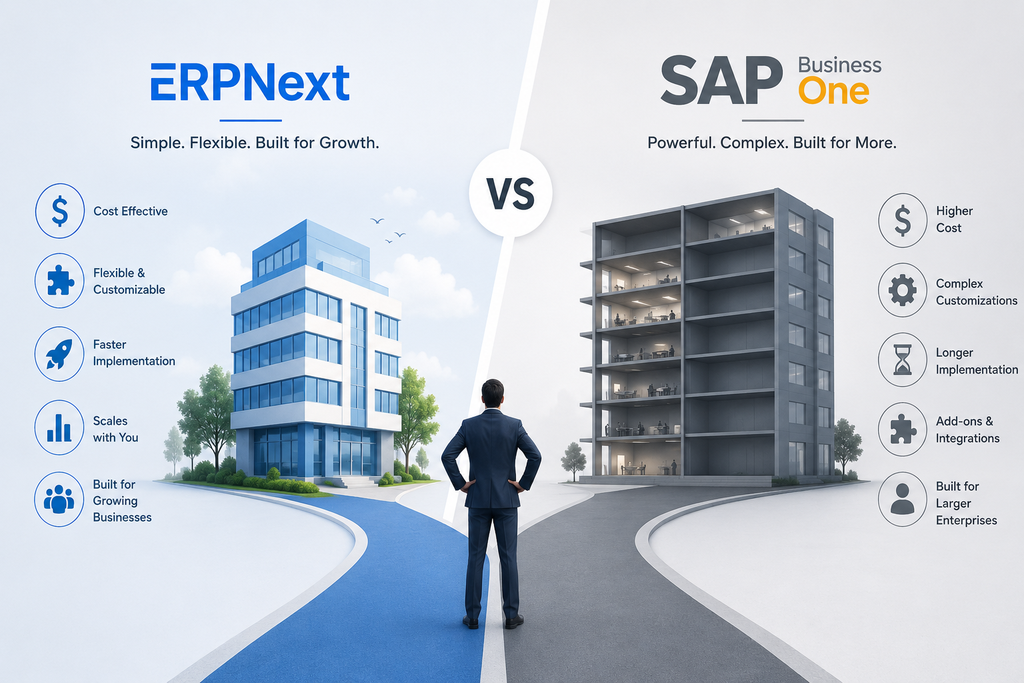
You know that feeling when you move into a huge office space because it looked impressive — but half the floors stay locked, the lights never turn on in those rooms, and you're still paying rent for all of it?
That's exactly what happens when a growing business picks the wrong ERP.
And right now, a lot of businesses are stuck in that situation — paying for a heavy, expensive system when all they needed was something that actually fits.
Let's talk about two names you've probably already come across: ERPNext and SAP Business One. Both are ERP solutions built for growing businesses. But they're built very differently — and that difference matters more than most people realise.
Many businesses exploring an ERPNext vs SAP comparison eventually realise that flexibility, implementation time, and long-term scalability matter just as much as features.
First, What's the Real Problem With Picking an ERP?
Most businesses don't fail at picking an ERP because they chose a "bad" software. They fail because they picked a system built for someone else's business.
SAP Business One was designed for mid-size companies with complex processes, dedicated IT teams, and a budget that allows for long implementation timelines. It's a well-built system — no question about it.
But if you're a growing business — whether you're in manufacturing, trading, retail, or services — you don't need a skyscraper. You need a building you can actually expand floor by floor, as your business grows.
That's where ERPNext implementation services become a practical option for growing businesses looking for flexibility and scalability.
ERPNext vs SAP Business One — What's Actually Different?
1. The Cost Isn't Just the Licence Fee
SAP Business One comes with a licence cost, implementation cost, customisation cost, and an ongoing maintenance cost. By the time you're live, you've spent a significant amount — and you haven't even started using it productively yet.
ERPNext, on the other hand, is open source. You're not paying per user for the software itself. Your investment goes into implementation, customisation, and support — which means the money actually goes toward making the system work for your business, not just for having access to it.
For a growing business watching every rupee, that's a meaningful difference.
2. Flexibility That Doesn't Need a Developer Every Time
SAP Business One customisations typically require certified SAP consultants and additional licences for add-ons. Want to change a workflow? Add a new field? Build a custom report? Each of those conversations turns into a project.
ERPNext is built on the Frappe Framework, which means customisation is part of its DNA. You can create custom fields, workflows, reports, and even new modules without touching a single line of code — or with minimal development if you need something deeper.
That kind of flexibility isn't a luxury for growing businesses. It's a necessity.
Businesses working with a certified ERPNext partner often find it easier to customise workflows without unnecessary complexity.
3. Implementation Time — Months vs. Weeks
SAP Business One implementations are known to run for months, sometimes longer. Every delay in go-live is a delay in your team actually working efficiently.
A well-executed ERPNext implementation — like the ones Tridots Tech handles as an ERPNext implementation partner in India — gets businesses live significantly faster.
Faster go-live means faster ROI, fewer disruptions, and your team spending less time in training rooms and more time doing actual work.
4. One System for Everything
ERPNext covers Accounting, Inventory, Manufacturing, HR, Payroll, CRM, Projects, and more — all within one unified system. There's no need to buy separate modules or integrate third-party tools for basic business functions.
SAP Business One covers a similar scope, but integrations and add-ons often come at an extra cost and add complexity to your tech stack.
5. Easy to Scale Without Starting Over
One of the biggest fears businesses have when choosing software is outgrowing it too quickly.
With SAP Business One, scaling often means additional licences, higher infrastructure costs, and more implementation layers.
ERPNext grows differently. You can start with the modules you need today and expand gradually as your operations evolve — without rebuilding the entire system from scratch.
That makes growth feel manageable instead of overwhelming.
6. Better Visibility Across Teams
When departments work on separate tools, communication gaps become unavoidable. Sales doesn't know what inventory looks like, finance waits for updates, and operations end up chasing information manually.
ERPNext keeps everything connected in one place, so teams work with the same real-time data instead of outdated spreadsheets and endless follow-ups.
The result? Faster decisions, fewer mistakes, and smoother day-to-day operations.
7. Built for Modern Businesses, Not Legacy Processes
A lot of traditional ERP systems still feel like they were designed for businesses from fifteen years ago. Complex screens, heavy workflows, and processes that slow people down instead of helping them work faster.
ERPNext offers a cleaner, more modern experience that teams adapt to quickly. Whether it's mobile access, workflow automation, or role-based dashboards, the system feels practical instead of intimidating.
8. Community-Driven and Continuously Improving
ERPNext isn't locked behind a closed ecosystem. It's backed by a strong global open-source community that continuously improves the platform with updates, features, and integrations.
That means businesses aren't dependent on a single vendor for innovation. The system evolves with changing business needs — which is exactly what growing companies need in the long run.
Who Should Actually Consider ERPNext?
If your business falls into any of these categories, ERPNext is worth a serious look:
- You're a growing SMB that needs structure but can't afford enterprise pricing
- You're currently running on spreadsheets or disconnected tools and things are starting to slip through the cracks
- You want a system that your team can actually use without a steep learning curve
- You need industry-specific customisations — especially in manufacturing, trading, or retail
- You're looking for a long-term partner, not just a software vendor
Why Tridots Tech?
At Tridots Tech, we've helped businesses across industries implement ERPNext in a way that actually sticks. Not just a technical deployment — but a system that maps to how your business actually runs.
As a provider of ERPNext services Chennai, we don't hand you a generic setup and walk away. We sit with your team, understand your processes, configure the system around them, and train your people to use it confidently.
If you've been looking at ERP options and feeling like everything is either too expensive, too complex, or too rigid — let's talk.
Why Businesses Choose Tridots Tech
- ERPNext implementation tailored to your workflow
- Faster deployment with minimal operational disruption
- Customisation and support from an experienced team
- Long-term guidance beyond implementation
Conclusion
SAP Business One is a capable system. But for most growing businesses, it's more room than you need — and you'll be paying for all of it.
ERPNext gives you a system that fits today, and scales with you tomorrow. Open source, flexible, and built for the way real businesses grow.
Stop paying for rooms you never use.
Want to see how ERPNext can work for your business?
Get in touch with Tridots Tech and let's figure it out together.
No comments yet. Login to start a new discussion Start a new discussion