Top 10 Inventory Challenges Businesses Face and How ERPNext Solves Them
Stockouts, excess inventory, and inaccurate stock records can create costly operational challenges. Here's a look at the most common inventory issues businesses face and how ERPNext helps solve them e
Inventory Problems Don't Usually Start in the Warehouse
Most inventory issues begin long before stock reaches a shelf.
They start with disconnected spreadsheets, delayed updates, manual entries, unclear stock visibility, and teams working with different versions of the same data.
I've seen businesses invest heavily in sales, procurement, and production while still struggling with stock-related issues. The result is familiar: delayed deliveries, excess inventory, unhappy customers, and cash locked in warehouses.
The good news is that these problems are not unique. More importantly, they are solvable.
Let's look at the most common inventory challenges businesses face and how ERPNext helps address them in day-to-day operations.
1. Not Knowing the Actual Stock Available
This is probably the most common issue.
The sales team says stock is available.
The warehouse team says it's not.
The purchase team has already placed a reorder because they think inventory is low.
Everyone is looking at different numbers.
What happens?
- Wrong customer commitments
- Delayed deliveries
- Emergency purchases
- Internal confusion
How ERPNext solves it
ERPNext provides real-time inventory visibility across warehouses, locations, and branches.
The moment stock moves through a purchase receipt, delivery note, stock transfer, or manufacturing process, inventory records are updated automatically.
Instead of relying on spreadsheets, every department works from the same source of truth.
2. Stockouts That Hurt Sales
Few things frustrate customers more than hearing:
"Sorry, that item is currently unavailable."
Frequent stockouts often indicate poor inventory planning rather than high demand.
Common reasons
- No reorder system
- Delayed purchase requests
- Inaccurate stock tracking
- Lack of demand forecasting
How ERPNext solves it
ERPNext allows businesses to set:
- Reorder levels
- Reorder quantities
- Safety stock limits
When stock reaches predefined thresholds, the system automatically alerts purchasing teams or generates material requests.
This helps businesses replenish inventory before it becomes a problem.
3. Excess Inventory Tying Up Cash
The opposite of stockouts can be equally damaging.
Many businesses purchase inventory "just in case."
Months later, warehouses are full of slow-moving products.
The hidden costs
- Storage expenses
- Damaged or expired inventory
- Reduced cash flow
- Lower inventory turnover
How ERPNext solves it
ERPNext provides inventory aging reports and stock movement analysis.
Business owners can quickly identify:
- Slow-moving items
- Non-moving inventory
- Overstocked products
Instead of making decisions based on assumptions, purchasing teams can work with actual inventory data.
4. Inventory Errors Caused by Manual Data Entry
Manual inventory tracking may work when a business is small.
As transaction volume grows, mistakes become unavoidable.
A missed entry or incorrect quantity can create hours of reconciliation work later.
Common issues
- Duplicate entries
- Wrong stock quantities
- Missing transactions
- Incorrect warehouse records
How ERPNext solves it
ERPNext automates inventory transactions across purchasing, sales, manufacturing, and warehouse operations.
Because stock movements are connected to business processes, there is significantly less manual intervention.
The result is better accuracy and fewer surprises during audits or stock checks.
5. Difficulty Managing Multiple Warehouses
Managing one warehouse is challenging enough.
Managing five or ten warehouses across different locations introduces an entirely new level of complexity.
Typical challenges
- Stock visibility issues
- Duplicate purchases
- Inter-warehouse transfers
- Location-specific inventory shortages
How ERPNext solves it
ERPNext supports multiple warehouses within a single system.
Teams can:
- Track inventory by location
- Transfer stock between warehouses
- Monitor warehouse-wise availability
- View consolidated inventory reports
This makes inventory management far more organized, especially for growing businesses.
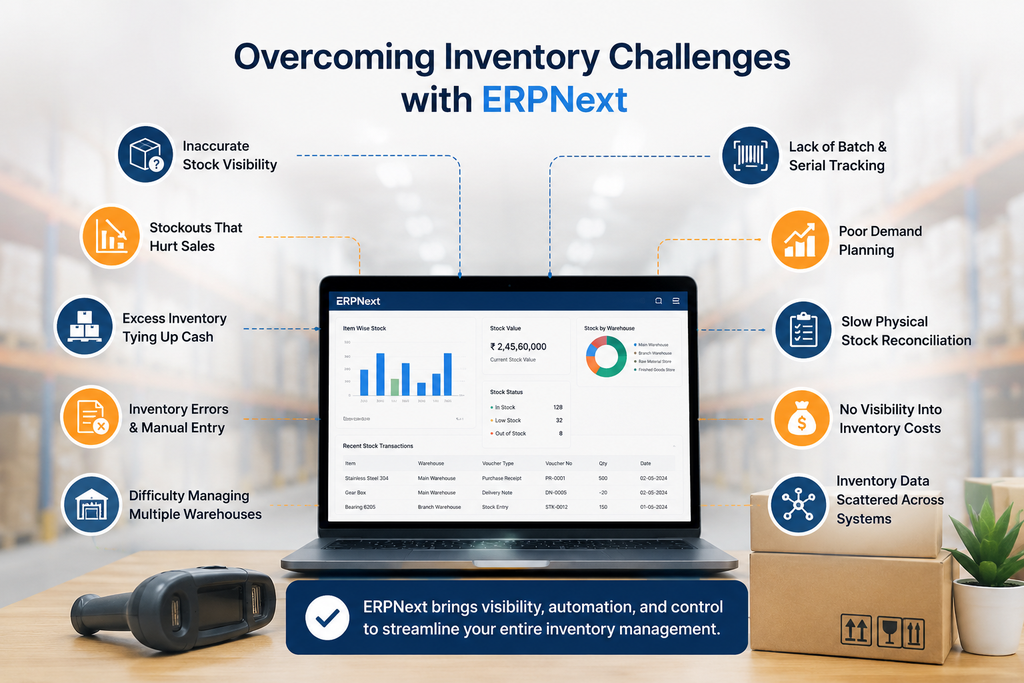
6. Lack of Batch and Serial Number Tracking
For industries like manufacturing, healthcare, electronics, food processing, and distribution, traceability is essential.
When issues arise, businesses must know exactly where a product came from and where it went.
Risks without tracking
- Product recalls become difficult
- Compliance issues
- Warranty disputes
- Poor quality control
How ERPNext solves it
ERPNext offers built-in:
- Batch management
- Serial number tracking
- Product traceability
Businesses can trace inventory from procurement through delivery with complete visibility.
7. Poor Demand Planning
Many businesses still rely on gut feeling when purchasing inventory.
That works until demand suddenly changes.
Then warehouses either run out of stock or end up carrying too much of it.
How ERPNext solves it
ERPNext provides historical inventory and sales data that helps businesses make informed purchasing decisions.
Managers can analyze:
- Sales trends
- Seasonal demand
- Product movement patterns
- Inventory consumption rates
Better planning leads to healthier inventory levels and improved cash flow.
8. Slow Physical Stock Reconciliation
Anyone who has conducted a stock audit knows how time-consuming it can be.
Often the system says one thing while the warehouse says another.
Then begins the hunt for missing transactions.
How ERPNext solves it
ERPNext includes stock reconciliation tools that simplify physical inventory verification.
Teams can:
- Conduct stock counts
- Adjust inventory discrepancies
- Maintain audit trails
- Generate reconciliation reports
This significantly reduces the effort required during stock audits.
9. No Visibility Into Inventory Costs
Many businesses know how much stock they have.
Fewer know exactly what that inventory is worth.
Without accurate valuation, profitability analysis becomes difficult.
How ERPNext solves it
ERPNext supports multiple inventory valuation methods, including:
- FIFO
- Moving Average
Business owners can track:
- Inventory value
- Cost of goods sold (COGS)
- Stock valuation reports
- Product profitability
This creates stronger financial visibility across operations.
10. Inventory Data Scattered Across Different Systems
One system handles sales.
Another handles purchasing.
Inventory lives in spreadsheets.
Accounting sits somewhere else.
The result is predictable.
Data mismatches.
Delays.
Manual follow-ups.
How ERPNext solves it
ERPNext connects inventory with:
- Sales
- Purchasing
- Manufacturing
- Accounting
- CRM
- Supply chain operations
Every transaction updates related departments automatically.
Instead of chasing information across multiple tools, teams work within a unified ERP environment.
Why Businesses Outgrow Traditional Inventory Tracking
Spreadsheets aren't the problem.
They simply stop scaling.
What works for 100 transactions per month rarely works for 10,000.
As businesses grow, inventory management becomes less about recording stock and more about controlling operational efficiency.
The companies that consistently maintain healthy inventory levels are usually the ones that have visibility, automation, and accountability built into their processes.
That's exactly where ERP systems create value.
Final Thoughts
Inventory challenges rarely exist in isolation.
A stockout may be caused by poor forecasting.
Excess inventory may stem from a lack of visibility.
Manual errors often arise because teams are forced to work with disconnected systems.
ERPNext addresses these issues by bringing inventory, purchasing, sales, manufacturing, and accounting into a single platform.
The result isn't just better stock management.
It's better business decisions.
If your team spends more time fixing inventory problems than preventing them, it may be time to evaluate how your current processes are working—and whether a connected ERP system can help simplify them.
About Tridots Tech
As a Frappe Gold Partner, Tridots Tech has helped businesses streamline inventory operations through successful ERPNext implementations across manufacturing, distribution, retail, and service industries. From warehouse management and stock tracking to procurement and production planning, our team helps organizations build inventory processes that scale with growth.
No comments yet. Login to start a new discussion Start a new discussion