ERP Software for Manufacturing Companies in India: What Should You Look For?
Choosing ERP software for manufacturing companies in India? See how ERPNext can connect production, inventory, purchasing, quality, and finance in one system.
ERP Software for Manufacturing Companies in India: What Should You Look For?
Picture an ordinary Monday at a mid-sized manufacturing unit. The production manager checks one Excel sheet for raw material stock. The purchase team works from a different file that hasn't been updated since Friday. Accounts has its own version of the numbers, while a manager is waiting for someone to confirm what's actually been produced this week.
None of this happens because the company has "too much data." It happens because that data lives in disconnected places, with nobody holding one reliable picture. This is usually when manufacturers start looking seriously at ERP software for manufacturing companies in India---not simply to replace spreadsheets, but to connect production, inventory, purchasing, quality, sales, and finance in one system.
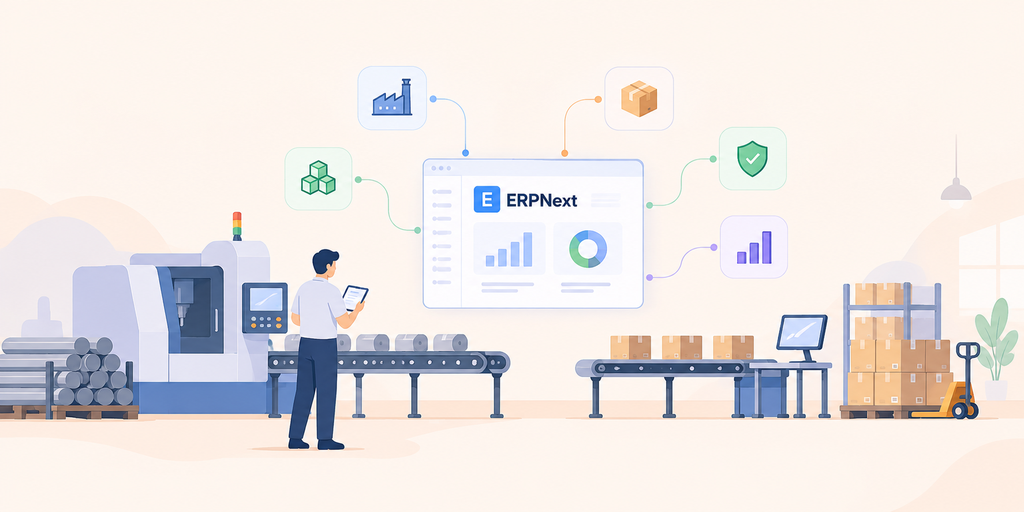
For manufacturers considering that move, ERPNext for Manufacturing is worth looking at because its manufacturing capabilities are built to connect production planning, Bills of Materials, Work Orders, inventory, quality, and reporting with other business functions.
Why Manufacturing Companies Need More Than Basic Accounting Software
A lot of manufacturers start with basic accounting software, and for a while, it works. Then the business grows, and it becomes clear that invoicing and ledgers were never the difficult part---the challenge is everything that happens between receiving an order and delivering a finished product.
Consider a simple scenario. A manufacturer receives an order for 500 units. On paper, that's one sales transaction. In reality, it immediately raises several questions: Do we have enough raw material? What needs to be purchased? How much should be produced? Which workstations are available? What's already in progress? When can the order realistically be completed?
This is where a manufacturing-focused ERP such as ERPNext becomes more relevant than a basic accounting system. ERPNext can connect sales demand with production planning, BOMs, material requirements, Work Orders, Job Cards, stock movements, and finished goods.
The goal isn't simply to have more software. It's to have fewer disconnected processes and a clearer flow of information from the order to production and delivery.
What Should You Look For in ERP Software for Manufacturing?
The biggest mistake manufacturers make is evaluating ERP systems purely through feature lists. A vendor can demonstrate dozens of features, but that doesn't tell you whether the system will work with your actual production process.
Instead, start with your manufacturing workflow and then evaluate how ERPNext can support those requirements. This keeps the decision focused on business needs rather than on whichever product happens to have the longest checklist.
1. Production Planning and Control
Production planning is where a manufacturing ERP needs to prove its value. You should be able to understand what needs to be manufactured, how much needs to be produced, what materials are required, and how production should be scheduled around available resources.
ERPNext's Production Plan can be used with Sales Orders or Material Requests and can help plan finished goods and the raw materials required for production. Work Orders can then be created from the production plan.
For a manufacturer handling multiple orders at the same time, this creates a more connected path from demand to production rather than relying on separate spreadsheets.
2. Bill of Materials and Manufacturing Workflows
A Bill of Materials, or BOM, is essentially the recipe for a finished product. It defines the materials, components, sub-assemblies, and operations required to manufacture it.
This becomes more complicated when a product has multiple components and sub-assemblies, each with their own requirements. ERPNext supports multi-level BOMs, allowing sub-assemblies to have their own BOM structures. BOMs can also be connected to operations used in the manufacturing process.
For manufacturers, this matters because inaccurate BOMs can affect material planning, purchasing, production, and costing. A well-maintained BOM therefore becomes an important foundation for the rest of the manufacturing workflow.
3. Inventory and Material Management
There is a difference between recording stock and actually understanding inventory. A manufacturing business needs visibility into raw materials, work-in-progress, finished goods, warehouse locations, and material requirements.
ERPNext's manufacturing workflow connects inventory with production, including the movement of materials into work-in-progress and finished-goods warehouses.
This becomes particularly useful when production teams need to answer a simple question: Do we have what we need to manufacture this order? Instead of reconciling separate spreadsheets, teams can work from information connected to the manufacturing process.
4. Purchasing and Supplier Management
Purchasing should not operate independently from production. If a production requirement exists but the required raw material isn't available, the purchasing team needs to know about it early enough to act.
ERPNext's Production Plan can help identify material requirements and create Material Requests for raw materials that need to be procured.
That doesn't eliminate the need for purchasing decisions or supplier management. It gives the purchasing team better information to work with and helps connect procurement activity with actual manufacturing requirements.
5. Quality Management
Quality shouldn't be treated as a completely separate process from manufacturing. Incoming raw materials may need inspection, while finished goods may require quality checks before dispatch.
ERPNext includes quality control capabilities that can be connected with manufacturing workflows. This helps businesses create a clearer record of quality-related activities instead of leaving critical checks only in notebooks or disconnected files.
The important point is traceability: teams should be able to understand what was checked, when it was checked, and how the result fits into the overall production process.
6. Finance and Cost Visibility
Manufacturing decisions eventually affect the financial side of the business. Material costs, production expenses, inventory valuation, and sales all influence how management understands margins and profitability.
This is one reason an integrated ERP is more useful than keeping manufacturing and accounting completely separate. ERPNext brings manufacturing together with accounting, inventory, purchasing, and sales, giving businesses a common system rather than forcing teams to repeatedly reconcile information between disconnected applications.
The exact accounting and costing setup still needs to be configured according to the company's processes and requirements.
7. Reporting and Real-Time Visibility
Ask a plant manager what they actually want from an ERP, and the answer is usually not "more reports." They want answers.
What is being produced today? Which orders are delayed? Which materials are short? What is happening on the shop floor? Which production activities are taking longer than expected?
ERPNext provides manufacturing reports and production-planning tools that can help teams monitor production, material availability, costs, and operational performance.
The important point is that reporting should support decisions---not simply create another collection of dashboards nobody uses.
8. Customization, Integration, and Scalability
No two manufacturing businesses operate in exactly the same way. One company may manufacture against Sales Orders. Another may produce for stock. Some may have multiple levels of sub-assemblies, subcontracting, multiple warehouses, or different production workflows.
ERPNext provides a flexible foundation, but that doesn't mean every business should customize everything. Unnecessary customization can make an implementation harder to maintain and more expensive to support over time.
The better approach is to identify the processes that genuinely require configuration, integration, or customization and then implement ERPNext around those business requirements.
9. Ease of Use and User Adoption
This is often overlooked during ERP selection. An ERP can have excellent functionality and still struggle if production staff, warehouse teams, purchasing employees, and accounts personnel don't understand how to use it in their daily work.
With ERPNext, implementation should therefore consider more than configuration. User roles, workflows, training, permissions, and shop-floor processes all need to be considered before going live.
An ERP succeeds when people actually use it---not when the software simply has the right features on paper.
Why ERPNext Is Relevant for Manufacturing Companies
ERPNext is an open-source, integrated ERP platform that brings manufacturing together with inventory, purchasing, sales, accounting, CRM, and other business functions. Its manufacturing capabilities include BOMs, Work Orders, Job Cards, Production Planning, Quality Control, Inventory Management, and reporting.
That integration is particularly relevant to manufacturers dealing with disconnected spreadsheets and departmental systems. Instead of treating production, inventory, purchasing, and finance as isolated activities, the business can work from processes that are connected within one ERP environment.
Take the earlier example of the 500-unit order. With an appropriately configured ERPNext implementation, the requirement can move through a connected process: the Sales Order creates demand, the Production Plan helps determine what needs to be manufactured and what materials are required, BOMs define the components, Work Orders manage production, Job Cards track operations, and inventory records the movement of materials and finished goods.
That doesn't mean ERPNext automatically solves every manufacturing problem. The quality of the implementation still depends on accurate master data, well-defined processes, appropriate configuration, user adoption, and ongoing support.
The software matters, but how it is implemented matters just as much.
Why Work With Tridots Tech for ERPNext Implementation?
Choosing ERPNext is only the beginning. For a manufacturing company, the implementation partner can have a major impact on whether the system actually fits the business.
Tridots Tech is a Frappe Gold Partner in India, with Manufacturing among its areas of expertise and ERPNext among its application expertise.
That manufacturing focus matters because an ERP implementation should begin with the business process---not with a generic software demo.
Before implementing ERPNext, the important questions are practical: How is production currently planned? How are BOMs maintained? How are raw materials issued to production? How is work-in-progress tracked? How does purchasing respond to shortages? How are quality checks recorded? How does management currently get production and financial information?
Once those processes are understood, ERPNext can be configured and extended where genuinely necessary. This approach is more useful than simply enabling every available feature and expecting the business to adapt around the software.
How to Evaluate ERPNext Before You Buy
Before committing to an ERPNext manufacturing implementation, work through these questions:
- Does ERPNext support our actual manufacturing workflow?
- Can our BOM structure, including multi-level assemblies, be managed properly?
- How will Production Plans and Work Orders work day to day?
- How will raw materials, work-in-progress, and finished goods be tracked?
- Can manufacturing requirements connect with purchasing?
- What quality checks need to be built into the workflow?
- What reports does management actually need?
- Which existing systems need to integrate with ERPNext?
- What configuration or customization is genuinely necessary?
- What training will production, warehouse, purchasing, and accounts teams need?
- How will Tridots Tech support implementation and post-go-live requirements?
These questions will tell you much more than a generic ERP feature comparison.
Final Thoughts
Choosing ERP software for a manufacturing company in India isn't about selecting the system with the longest feature list. It's about choosing a platform that fits your manufacturing processes, connects departments, improves visibility, and can be adopted by the people who use it every day.
ERPNext is a strong option for manufacturers looking for an integrated, open-source ERP platform with dedicated manufacturing capabilities, including production planning, BOMs, Work Orders, Job Cards, inventory, quality, and reporting.
And the implementation should be treated as a business transformation project---not simply a software installation.
If your manufacturing business is evaluating ERPNext, Tridots Tech can help assess your existing workflows, identify the right ERPNext configuration, and plan an implementation around how your manufacturing operations actually work.
No comments yet. Login to start a new discussion Start a new discussion