How to Track Manufacturing Scrap and Production Loss in ERPNext
Manufacturing scrap can quietly add to production costs. Learn how ERPNext helps track material consumption, production output, scrap, and production loss in one place.
How to Track Manufacturing Scrap and Production Loss in ERPNext
A production batch rarely ends exactly as planned.A manufacturing team may start with a defined quantity of raw material and a clear production target. But once the process is complete, the actual result can look different. Some material becomes finished goods, some remains usable, and some may be rejected, damaged, or converted into scrap.The challenge is not simply that scrap exists. The bigger question is how much material was lost, where the loss happened, and whether it was within an acceptable range.
When production teams record these details in notebooks, spreadsheets, or separate files, it becomes difficult to connect material consumption with actual production. A small difference in one batch may not seem important, but repeated across hundreds of production runs, it can become a significant cost.This is where Erpnext manufacturing scrap tracking can help. By connecting manufacturing activities with inventory and production records, ERPNext gives businesses a more structured way to record material consumption, production output, and scrap. The exact workflow can vary depending on the manufacturing process and ERPNext configuration.
What Is Manufacturing Scrap and Production Loss?
Manufacturing scrap is material generated during a production process that is no longer useful for its original purpose. In some cases, scrap may still have recoverable material value or may be recycled. It is therefore useful to distinguish scrap from other types of leftover or secondary output.
Production loss is a broader concept. It can describe the difference between what was expected from a production process and what actually happened. This could include higher-than-planned material consumption, process loss, rejected output, or other differences between planned and actual production.
Consider a simple example. A manufacturer starts a production batch with 100 kg of raw material. After processing, 92 kg contributes to the finished output, 5 kg remains as usable material, and 3 kg becomes scrap.
The 3 kg of scrap should not simply disappear from the records. Recording what happened to that material gives the business a clearer picture of the production batch and helps explain the difference between the material that entered production and the useful output that came out of it.
The way scrap is classified and valued can depend on the manufacturing process and business rules. The important part is to establish a consistent method for recording it.
Why Should Manufacturers Track Scrap?
Scrap tracking is about more than knowing how much material was discarded. When recorded consistently, scrap can become useful production information.One obvious area is material cost. If a process repeatedly consumes more raw material than expected, the additional consumption can affect the actual cost of producing the finished item. For a company manufacturing thousands of units, even a small amount of excess material per unit can add up over time.
Scrap can also provide clues about production efficiency. Imagine a cutting operation that usually generates around 2% process loss. If several recent batches are producing 5%, the production team has a reason to investigate. The increase could be related to the material, machine settings, production setup, or another operational factor.
There can also be a connection with quality problems. Repeated rejected or defective material may point toward issues in raw material quality, machine operation, production methods, or quality control. Scrap data alone does not identify the cause, but it gives the team a useful starting point for investigation.
Another important area is inventory accuracy. If material is consumed or becomes scrap but the transaction is not properly recorded, the quantity in the system may no longer match what is physically available. Over time, these differences make inventory planning and production decisions more difficult.
Most importantly, consistent scrap records help manufacturers move from assumptions to evidence. Instead of saying, “This process usually wastes around 2%,” the production team can review actual records and see whether that assumption still holds.
How ERPNext Can Help Track Manufacturing Scrap
ERPNext's Manufacturing module connects production activities with inventory and related manufacturing records. Depending on the company's workflow, the process can involve a Bill of Materials (BOM), Work Order, Job Cards, and Stock Entries.
The Bill of Materials is an important starting point because it defines the components and quantities required to manufacture an item. ERPNext also allows scrap or secondary outputs to be defined in the BOM. In ERPNext v16, the earlier Scrap Items table was renamed Secondary Items, and it can include scrap, co-products, by-products, and additional finished goods.
A Work Order then provides the production requirement and calculates required material based on the BOM. ERPNext can track required, transferred, and consumed quantities for materials associated with the Work Order.
During production, Stock Entries record inventory movements. ERPNext supports manufacturing-related purposes such as Material Transfer for Manufacture, Material Consumption for Manufacture, and Manufacture entries. These transactions help record the movement and consumption of raw materials as production takes place.
Job Cards add another level of operational tracking. They are used to record actual production information for individual operations and workstations. When scrap is generated while completing an operation, the scrap details can be recorded in the Job Card and added to inventory.
Together, these records can give a manufacturer a clearer view of what was planned, what material was consumed, what was produced, and what scrap was generated.
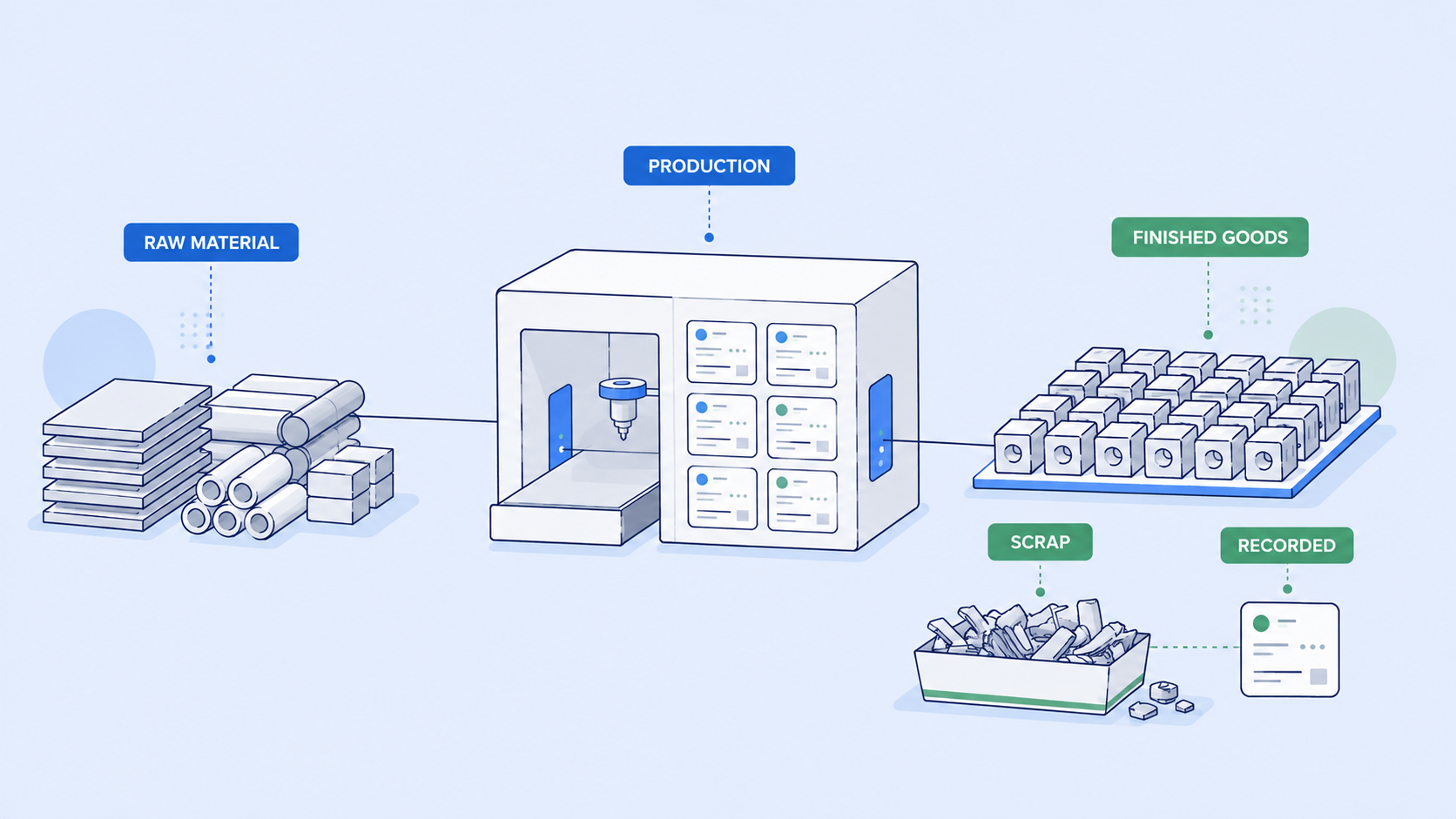
A Practical Example: Tracking Scrap in a Production Batch
Imagine a manufacturer producing 1,000 metal components.The company's BOM defines the materials required for the product. A Work Order is created for the production quantity, and the required materials are made available for manufacturing.
During production, the team notices that the actual material consumption is higher than expected. After reviewing the batch, they identify several possible sources of loss: cutting waste, rejected pieces, and material damaged during machine setup.Instead of recording only the final quantity of finished components, the team records the relevant material consumption and scrap generated during the production process.
Now the production manager has more useful information to work with.They can compare the actual material consumed against what was expected. They can also look at whether the same type of loss appeared in previous batches. If the difference occurs repeatedly, the team can investigate whether the problem is related to material quality, machine settings, production methods, or the assumptions used in the BOM.
This changes the conversation from “We had some wastage in production” to “This process is consistently consuming more material than expected, so what is causing the difference?”That is a much more useful question for a production team.
Expected Scrap vs Actual Scrap
A manufacturer does not necessarily need to treat every amount of scrap as a problem. Some production processes naturally create a certain amount of loss.
What matters is understanding the difference between expected and actual performance.
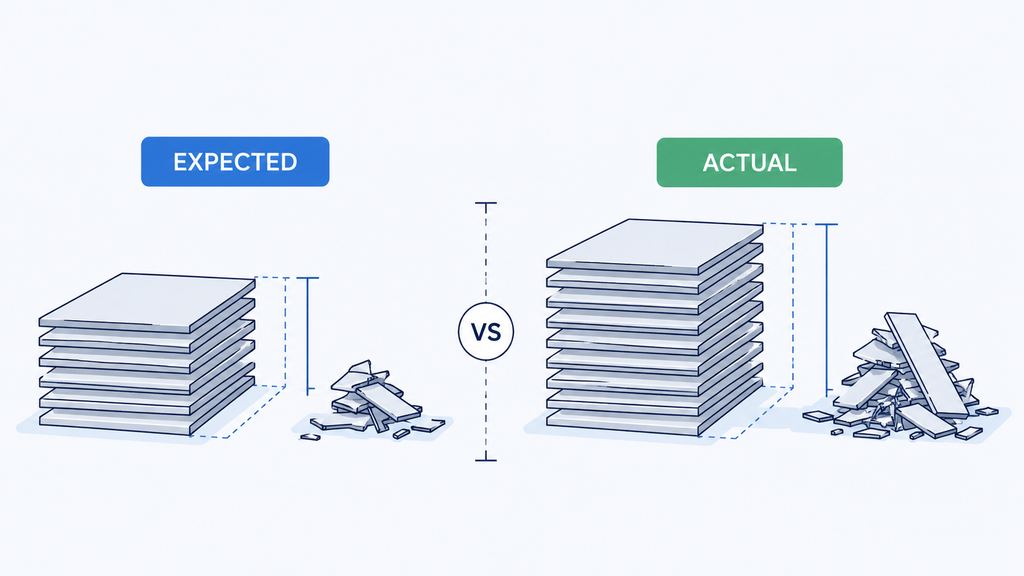
Suppose a process normally has an expected scrap rate of 2%, but a particular batch records 5%. The difference does not automatically prove that there was a production failure. However, it is large enough to deserve investigation.The production team might examine the raw material quality, machine calibration, production setup, cutting method, operator practices, or quality rejection rate. They might also review whether the BOM accurately reflects the current production process.
These are possible causes rather than automatic conclusions. The value of maintaining consistent records is that the team has actual production data to investigate rather than relying entirely on assumptions.Over time, comparing multiple batches can be even more useful. One unusual result may be an exception. The same difference appearing repeatedly can indicate a process that deserves closer attention.
How Scrap Data Helps With Production Cost Control
Material consumption tells only part of the production story.Consider two batches that both produce 1,000 finished units. The first batch consumes 500 kg of raw material, while the second consumes 530 kg. From the finished-goods quantity alone, the two batches look identical. From a material-consumption perspective, they are clearly different.If the additional 30 kg is not properly recorded or investigated, management may miss an important difference in production performance.
This is why manufacturers should look at scrap alongside the wider production picture:
Material Consumption → Production Output → Scrap or Wastage → Actual Production Performance
The goal is not to eliminate every gram of scrap. That would not be realistic for many manufacturing processes. The goal is to understand what is being lost, whether the loss is expected, and whether repeated differences point to an opportunity for improvement.
ERPNext can support this by connecting production and stock transactions, giving teams a more consistent record of material movement and consumption.
Common Mistakes Manufacturers Make When Tracking Scrap
One common mistake is recording scrap only at the end of the month. By then, it may be difficult to remember which batch generated the loss or what happened during the production process. Recording information closer to the time of production gives the team better context.
Another problem is keeping scrap records separately in Excel. A spreadsheet might show the amount of scrap while the inventory system records material consumption somewhere else. Someone then has to compare the two manually, which adds work and can create discrepancies.
Manufacturers can also run into problems when all scrap is treated as one category. Different types of scrap may have different causes, and separating them appropriately can make the information more useful for analysis.Another common mistake is looking only at the actual scrap quantity without comparing it with expected performance. Knowing that 50 kg was scrapped tells you what happened, but not whether 50 kg was normal for that process.
Finally, looking at one production batch in isolation can hide recurring patterns. Comparing production performance across multiple batches can help identify whether a particular type of material loss is occasional or becoming a regular issue.
Why ERPNext Is Useful for Scrap and Production Loss Tracking
The value of ERPNext is not simply that it gives manufacturers another place to record scrap. Its bigger advantage is the connection between the different parts of the manufacturing process.A business can work with BOMs, Work Orders, Job Cards, material consumption, Stock Entries, inventory movements, and production records within a connected ERP environment.With an appropriate manufacturing workflow and configuration, this gives production and management teams a more consistent way to answer practical questions.
Which batches are consuming more material than expected? Is a particular type of scrap appearing repeatedly? Is the actual process loss within the expected range? Does the BOM still represent what is happening on the shop floor? Are inventory records reflecting the material that was actually consumed?
ERPNext does not eliminate manufacturing scrap, and it does not guarantee zero production loss. What it can do is help businesses record and analyse production information more consistently, so teams have better information when investigating material losses and production variances.
Final Thoughts
Scrap is not just a number to be written down at the end of a production cycle. It can tell a story about how a manufacturing process is performing.A few kilograms of unexplained material loss may not seem significant in one batch. When the same difference occurs across hundreds of batches, however, the cost can become much more noticeable. Without consistent records, it is difficult to know whether the loss is expected, accidental, or the result of a recurring production issue.
That is why manufacturing scrap tracking in ERPNext should be considered part of the wider production and inventory process. When material consumption, production output, and scrap are recorded in a structured way, manufacturers have better information to understand their actual production performance.
For manufacturers still managing scrap, production loss, and material consumption across spreadsheets and disconnected records, ERPNext can provide a more connected approach to manufacturing management. Tridots Tech, a Frappe Gold Partner, helps businesses implement and configure ERPNext around their manufacturing, inventory, and operational requirements.
No comments yet. Login to start a new discussion Start a new discussion