Why Manufacturing Delays Usually Start Long Before Production
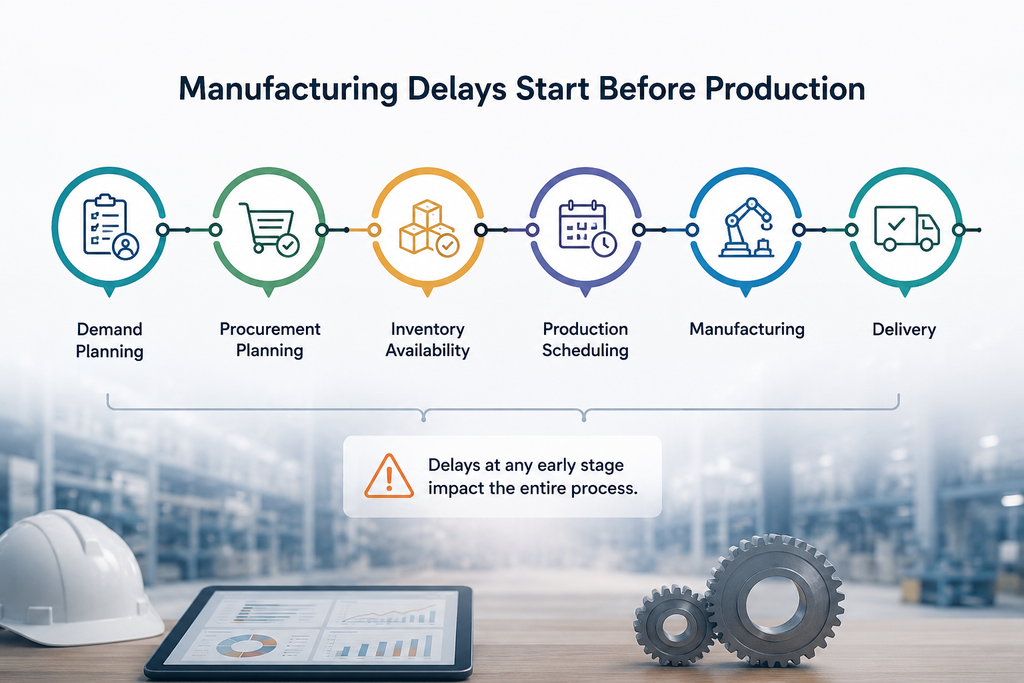
Manufacturing delays often begin long before production starts. Planning gaps, inventory issues, and procurement delays can impact timelines, costs, and delivery commitments.
Why Manufacturing Delays Usually Start Long Before Production
Manufacturing delays are often associated with what happens on the shop floor. A machine stops unexpectedly, a raw material shipment arrives late, or a production team struggles to meet a deadline. While these issues are visible and easy to identify, they are rarely the actual starting point of the problem.
In many manufacturing businesses, delays begin weeks—or even months—before production starts. They originate in planning gaps, disconnected processes, inaccurate inventory records, unclear procurement timelines, and the lack of real-time visibility across departments.
Over the years, manufacturers have invested heavily in machinery, production capacity, and workforce development. Yet many continue to experience missed delivery commitments, rising operational costs, and production delays. The common factor is often not production itself, but the processes that support it.
This is where a modern manufacturing ERP system plays an important role. Businesses using Erpnext Manufacturing solutions gain better visibility into planning, procurement, inventory, production scheduling, and delivery operations from a single platform.
The Hidden Cost of Delays Before Production
A manufacturing order does not begin when the first machine starts running.
It begins when a customer order is confirmed, when material requirements are calculated, when procurement decisions are made, and when production schedules are prepared.
When any of these steps are handled manually or through disconnected systems, delays start accumulating quietly.
Common early warning signs include:
- Inaccurate material planning
- Delayed purchase requests
- Inventory discrepancies
- Unclear production schedules
- Lack of coordination between departments
- Duplicate data entry across multiple systems
- Delayed approval processes
By the time production teams notice the issue, valuable time has already been lost.
Poor Demand Planning Creates a Chain Reaction
Many manufacturers still rely on spreadsheets for forecasting and production planning.
While spreadsheets may work for small operations, they become difficult to manage as order volumes increase. Forecasting errors can lead to two major problems:
Overproduction
Producing more than required ties up working capital, occupies warehouse space, and increases inventory carrying costs.
Underproduction
Producing less than required results in stock shortages, rushed procurement, delayed deliveries, and dissatisfied customers.
A connected ERP system helps manufacturers align customer demand, inventory availability, and production capacity. Instead of reacting to problems, teams can make informed decisions based on real-time information.
Procurement Delays Often Begin with Limited Visibility
Raw materials are the foundation of manufacturing operations.
However, procurement teams often face challenges when they lack visibility into actual inventory levels and future production requirements.
Consider a simple example:
A production manager assumes sufficient stock is available for a large order. When production begins, the team discovers a critical component is unavailable. Procurement then places an urgent order, suppliers require additional lead time, and production schedules are pushed back.
The delay appears to be a procurement issue, but the root cause is often poor planning and inventory visibility.
With erpnext manufacturing, procurement teams can access material requirements, purchase planning, and stock information from a unified system, reducing avoidable delays.
Inventory Inaccuracies Cause Production Delays
Inventory accuracy is one of the most overlooked factors in manufacturing efficiency.
When stock records do not match physical inventory, production teams face unexpected interruptions.
Common causes include:
- Manual stock updates
- Delayed inventory entries
- Unrecorded material movements
- Multiple systems storing conflicting information
Even a small discrepancy can affect production schedules.
Modern ERP systems provide real-time inventory tracking and stock visibility, allowing teams to identify shortages before they affect production.
This proactive approach helps manufacturers maintain smoother workflows and improve delivery performance.
Production Scheduling Problems Start Earlier Than Expected
Many production delays are blamed on machine capacity or labor availability.
In reality, production scheduling issues often originate during planning.
For example:
- Production orders may be scheduled without confirming material availability.
- Resource capacity may not be accurately calculated.
- Priority orders may disrupt existing schedules.
- Departments may operate using different versions of production data.
When schedules are built on incomplete information, delays become almost unavoidable.
An integrated ERP platform helps align materials, resources, workstations, and timelines before production begins, creating a more realistic and achievable production plan.
Disconnected Systems Slow Decision-Making
Manufacturing operations involve multiple departments working together:
- Sales
- Procurement
- Inventory
- Production
- Quality
- Finance
- Logistics
When these departments use separate software applications, information moves slowly.
A sales team may commit to a delivery date without knowing current production capacity. Procurement may not be aware of upcoming demand. Production teams may not have visibility into supplier delays.
This lack of coordination increases operational risk.
Businesses increasingly seek integration with multiple apps to connect critical business functions and eliminate information gaps. A connected ecosystem ensures that every department works with the same data, reducing misunderstandings and improving response times.
The Impact on Customer Commitments
Customers rarely see the internal reasons behind manufacturing delays.
They only see missed delivery dates.
Repeated delays can affect:
- Customer trust
- Contract renewals
- Revenue growth
- Brand reputation
- Long-term business relationships
Manufacturers that consistently meet delivery commitments usually have strong planning, inventory, and production management processes behind the scenes.
The ability to track operations from order receipt to delivery provides a significant operational advantage.
Why Manufacturers Are Moving Toward ERP-Driven Operations
Manufacturing businesses today operate in a more competitive environment than ever before.
Customers expect faster delivery times, better product availability, and accurate order tracking.
Traditional methods of managing operations through spreadsheets and disconnected systems make it difficult to meet these expectations.
This is why many organizations evaluate erpnext with other erps studies before selecting a manufacturing platform. They look beyond accounting capabilities and focus on operational visibility, production planning, inventory management, and scalability.
ERPNext has gained attention because it combines these capabilities within a unified system while remaining flexible for manufacturers of different sizes.
The Role of an Experienced Implementation Partner
Technology alone does not solve manufacturing challenges.
The success of an ERP project depends heavily on implementation strategy, process understanding, and business alignment.
Working with an experienced certified frappe partner helps manufacturers configure the system according to their operational requirements rather than forcing standard processes that may not fit their business model.
A well-planned implementation ensures:
- Accurate master data setup
- Effective inventory workflows
- Streamlined procurement processes
- Realistic production planning
- Meaningful reporting and analytics
These factors contribute directly to reducing delays before production begins.
How Tridots Tech Helps Manufacturers Improve Operational Visibility
As a trusted erpnext partner in india, tridots tech has worked with organizations seeking better control over manufacturing operations, inventory management, procurement workflows, and business reporting.
The objective is not simply software implementation. The focus is on identifying process gaps that create delays and building systems that support smoother operations.
Through tailored ERP implementations, process optimization, and integration with multiple apps, manufacturers gain the visibility needed to make faster and more informed decisions.
Businesses looking for reliable erpnext services in chennai often prioritize practical implementation experience, industry understanding, and long-term support. These factors play a critical role in ensuring ERP adoption delivers measurable operational improvements.
Conclusion
Manufacturing delays rarely begin on the production floor.
In most cases, the root causes are hidden within planning, procurement, inventory management, and communication processes that take place long before production starts.
When manufacturers rely on disconnected systems and limited visibility, small inefficiencies accumulate into larger operational challenges. The result is delayed production, missed delivery commitments, and higher operating costs.
By improving visibility across departments and connecting critical business functions through a modern ERP platform, manufacturers can address issues before they reach the production stage.
The most successful manufacturing operations are not necessarily those with the largest facilities or the newest machinery. They are the ones that identify potential delays early, make informed decisions quickly, and maintain control over every stage of the manufacturing process.
No comments yet. Login to start a new discussion Start a new discussion