GO1CMS: Visual Website Builder for Modern Businesses
GO1CMS is a visual website builder that helps businesses create responsive websites, work with real business data, build forms, and publish with ease.
GO1CMS: When Your Website Needs to Do More Than Look Good
A website can look great and still create a lot of work behind the scenes. A product team may be updating product information in one place while someone else is manually changing the same information on the website. A marketing team may spend hours adjusting the same colours across different pages, while a contact form may collect enquiries that later need to be entered into the business system.
Then there is another familiar problem: a website looks perfect on a laptop, but something feels wrong when you open it on a phone. As a website grows, the challenge is no longer just about making pages look good. It is also about managing content, working with real data, maintaining consistency, and keeping the publishing process under control.
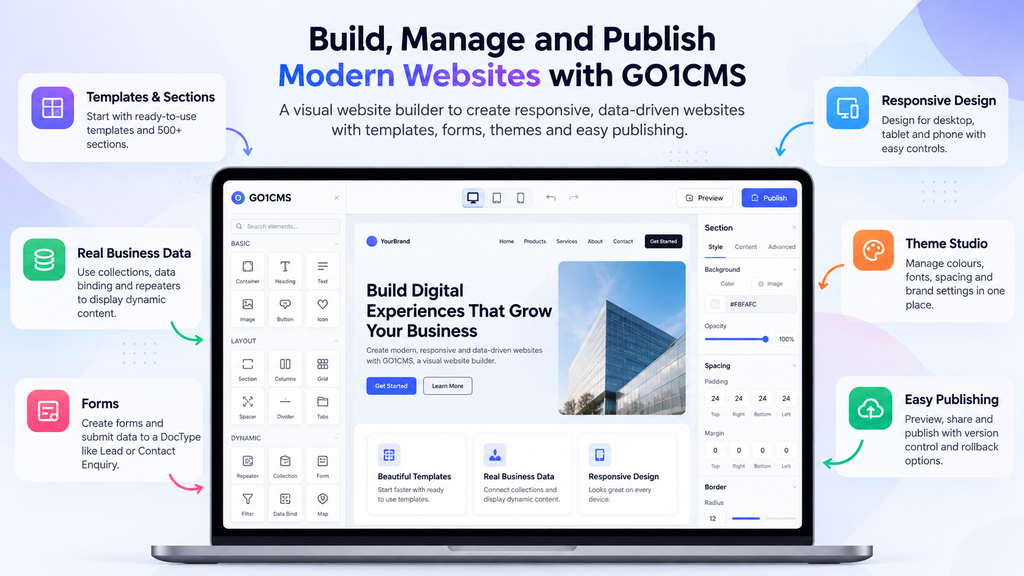
This is where GO1CMS, a visual website builder built on the Frappe framework, takes a practical approach. It combines visual page building with structured data, reusable sections, responsive controls, forms, themes, and versioned publishing. For businesses already working with Frappe or ERPNext, this makes GO1CMS particularly relevant as a way to build and manage their web presence within the Frappe ecosystem.
What Makes GO1CMS Different?
At first glance, GO1CMS looks like a website builder. You open a canvas, add sections and elements, edit text, arrange layouts, adjust styles, and publish the page. But the builder goes beyond simply placing content on a screen.
Pages can be connected to real data through collections and data binding. Repeaters can display rows from a collection, filters can change the data shown on a page, and forms can submit information to a DocType. At the same time, Theme Studio provides a common visual foundation for colours, typography, spacing, and other design choices.
Consider a business that sells several products. Instead of treating every product card as a separate piece of manually maintained website content, product information can come from a collection connected to a DocType. A repeater can then use that data to display the products on the page. As the website becomes larger, having this relationship between the page and the underlying data becomes increasingly useful.
Start With a Design, Not a Blank Page
One of the first challenges in website creation is often not knowing how to code. It is knowing where to begin. A completely blank canvas gives you unlimited freedom, but it also means every section, layout, and design decision has to be created from scratch.
GO1CMS provides Templates, Sections, and Elements through its insert panel, giving users different ways to start building a page. The section library contains several hundred brand-neutral sections across more than thirty categories. These can be added to a page and then edited like normal elements, rather than remaining as fixed or locked blocks.
There are also complete website templates covering areas such as agencies, e-commerce, portfolios, restaurants, and SaaS. A template can bring pages, menus, themes, and sections into a project, giving a business a starting structure that can then be adapted to its own content.
For example, imagine a small design agency preparing a new website. Instead of starting with an empty page, the team could begin with an agency template, replace the sample content with its own information, upload its images, adjust the colours and fonts, and remove pages it does not need. The template provides the starting point, while the final design remains editable.
Your Website Has to Work on a Phone Too
A website can look different across screen sizes, which is why responsive controls matter while building a page. GO1CMS provides Desktop, Tablet, and Phone views directly in the builder, allowing users to work with different screen sizes while editing.
GO1CMS lets users select a device while editing and adjust styles for that particular screen size.GO1CMS also supports flex and grid layouts, spacing controls, responsive sizing, and visibility settings for different devices. This gives designers control over how elements are arranged and displayed across screen sizes.
This makes responsive design part of the page-building process rather than something that has to be handled separately after the desktop version is created.
The Website Can Work With Real Business Data
This is where GO1CMS becomes more than a conventional visual website builder. Many business websites depend on information that already exists as structured data. Products, blog posts, team members, and other records may already be maintained through DocTypes or other data sources.
GO1CMS uses Collections to make this information available to website pages. A collection can use a DocType, a saved Query Builder query, or an external API. Once the collection is configured, page elements can be connected to its fields through data binding.
Take a product catalogue as an example. A business could create a collection from its product DocType and expose fields such as the product name, image, and description. A Repeater can then display those records as product cards, with each element connected to the relevant field.
The same approach can be extended with filters. A Filter element can write its value into the page URL, while a repeater can use that parameter to refetch matching records. This allows visitors to interact with a product or content listing while the page continues to work with the underlying data.
GO1CMS also supports detail pages using routes such as /products/:slug. A product card can link to an individual route, allowing the corresponding record to be displayed on its own page. For a website with changing or growing content, this provides a structured way to work with individual records and listings.
A Contact Form Can Become a Business Record
A website is not only a place to display information. For many businesses, it is also one of the places where enquiries begin. A visitor may want to request information, ask for a callback, or submit an enquiry about a product or service.
GO1CMS includes Form Builder and a Form element for this purpose. A business can create a form for a DocType such as Lead or Contact Enquiry, with fields such as name, email, phone, and message. The form can then be placed on a website page and styled through the builder.
The form's submit event can also trigger actions. For example, the website can display a confirmation message such as “Thanks, we will call you” and then navigate the visitor to a /thank-you page. The submitted information can be checked from the administration area, where the form submission and Lead record are available.
For a consulting company, for example, this creates a straightforward flow from a visitor submitting an enquiry on the website to that information being stored as a Lead. The website is therefore not simply displaying a contact form; it is connecting the visitor's submission with structured business data.
One Theme Can Shape the Entire Website
Website consistency can become difficult as more pages are added. The homepage may use one shade of a brand colour, another page may use a slightly different version, and individual sections may gradually develop different typography and spacing.
GO1CMS includes Theme Studio to help establish these design decisions at the project level. A theme can define colour roles, heading and body fonts, a type scale, spacing steps, and radii. Each project can also have a brand kit containing a logo, favicon, primary colour, and secondary colour.
Theme tokens can be used by library sections and inspector settings. When a section or setting references a token, changing that token can update the areas that use it. For example, if a business changes its primary brand colour, theme-based sections can follow the updated colour without requiring every section to be treated as a completely separate design.
This gives the website a shared visual foundation while still allowing individual pages and elements to have their own overrides where needed.
Publishing Does Not Have to Mean Losing the Previous Version
Website changes rarely happen only once. A homepage gets updated, a campaign ends, a new design is introduced, or a section is changed and later needs to be restored. That makes version control useful even for a website.
GO1CMS separates the working draft from the published version. Changes are autosaved while you work, but visitors do not see those changes until you publish. Each publish creates a numbered version containing the project's pages, menus, and theme settings.
If an earlier version needs to be restored, the control panel provides a Rollback option. A rollback itself becomes a new version, so the previous history is not simply overwritten. GO1CMS also provides Preview and Share options, allowing a draft to be reviewed before it becomes the live version.
For example, a marketing team could prepare a new homepage, share the draft with a colleague or client, make changes based on the review, and publish the approved version. The workflow keeps the editing process separate from what visitors see on the live website.
Hosted or Self-Hosted? You Have a Choice
GO1CMS can be used as a hosted service or installed as a self-hosted application. With the hosted option, users create an account, choose a plan, and create websites through the GO1CMS control panel. The Starter plan is free, while Medium and Premium provide additional capabilities such as custom domains.
For organisations that prefer to manage their own infrastructure, GO1CMS can also be installed using bench get-app on a Frappe bench. It can run wherever Frappe runs, with infrastructure and updates managed by the self-hosting team.
The hosted service and the open-source applications use the same code. The control panel responsible for plans and website provisioning is a separate application and is not required for self-hosted installations.
Why GO1CMS Fits the Frappe Ecosystem
For businesses already using Frappe or ERPNext, the connection is particularly relevant. GO1CMS is built on Frappe and works with concepts such as DocTypes, collections, forms, APIs, data binding, and structured business information.
For example, a business could maintain product information through a DocType, expose selected fields through a collection, and display those records through a website repeater. A separate detail page could then display an individual product using its route parameter.
This does not mean every ERPNext implementation automatically becomes a GO1CMS website. Instead, GO1CMS provides a Frappe-based website builder that can work with structured business data while giving users a visual way to build the website.
At Tridots Tech, a Frappe Gold Partner and ERPNext expert, we work within the Frappe ecosystem and build solutions around Frappe and ERPNext. GO1CMS adds a visual approach to website creation for organisations that want to build, manage, and publish websites while working within that ecosystem.
A Website Should Work as Hard as the Business Behind It
A business website is expected to do more than look polished. It needs to work across different devices, present information clearly, support changing content, collect enquiries, maintain a consistent visual identity, and give teams control over what gets published.
GO1CMS brings these requirements into a visual website-building environment. You can begin with a template, build with editable sections and elements, adjust layouts for different devices, connect pages to real data, create forms, define a project theme, preview changes, and publish controlled versions of the website.
That is what makes GO1CMS interesting: the website is not treated only as a design surface. It can also act as a visual layer for structured business information.
For businesses exploring a Frappe website builder, or for teams already working with Frappe and ERPNext, GO1CMS provides a practical way to bring website design and business data together.
No comments yet. Login to start a new discussion Start a new discussion