ERPNext Implementation Cost in India: What Should Your Business Budget For?
How much does ERPNext implementation cost in India? This is one of the first questions businesses ask when evaluating ERPNext for their operations.
The cost depends on what your business needs from the system. A trading company implementing sales, purchasing, inventory and accounting will have a different project scope from a manufacturer managing production, multiple warehouses, quality checks and customized workflows.
ERPNext is open-source software, but implementing it involves more than installing the application. Businesses must consider requirement analysis, configuration, data migration, customization, integrations, hosting, employee training and ongoing support.
In this guide, we explain the major factors that influence ERPNext implementation cost in India, the expenses to include in your budget and how to prepare before requesting an implementation quotation.
Businesses evaluating implementation partners can also read our guide to the Best ERPNext Implementation Partner in India in 2027 to understand what to look for when selecting a provider.
How Much Does ERPNext Implementation Cost in India?
There is no single fixed price for ERPNext implementation. The total cost depends on the business processes, modules, customization, data migration, integrations, infrastructure and support included in the project.
For example, a small distributor may need basic buying, selling, stock and accounting workflows. A manufacturing company may require additional configuration for production planning, Bills of Materials, Work Orders, quality inspections and warehouse operations.
These projects have different requirements and implementation efforts.
Instead of relying on a generic price estimate, businesses should request a quotation based on their actual requirements and clearly defined project scope.
(What Is Included in ERPNext Implementation Cost?
ERPNext implementation cost generally covers several activities involved in preparing the system for business use.
| Cost component |
What it covers |
| Requirement analysis |
Understanding business processes and requirements |
| Configuration |
Setting up modules, workflows and permissions |
| Customization |
Developing additional functionality where required |
| Data migration |
Preparing and transferring existing business data |
| Integrations |
Connecting ERPNext with other applications |
| Deployment |
Setting up cloud or on-premise infrastructure |
| Testing |
Checking workflows, records and business transactions |
| Training |
Preparing employees to use the system |
| Support |
Assistance after implementation and go-live |
Not every project requires all these activities to the same extent. The implementation proposal should clearly explain what is included and what will be charged separately.
8 Factors That Affect ERPNext Implementation Cost
1. Business Size and Process Complexity
Business size can influence implementation requirements, but the number of employees alone does not determine the project cost.
A business operating from one location with straightforward sales and inventory processes may require a relatively simple setup.
A company with multiple branches, warehouses, approval levels and departments may need additional configuration and testing.
Before implementation, the partner should understand:
- Number of departments and business locations
- Existing business processes
- Approval workflows
- Reporting requirements
- Warehouse and inventory structure
- User roles and access permissions
The more complex the business processes, the more carefully the implementation scope needs to be planned.
2. ERPNext Modules Required
ERPNext provides different modules for managing business operations. The modules selected for implementation influence the project scope.
| ERPNext module |
Main business requirement |
| Accounting |
Financial transactions and reports |
| Buying |
Supplier and procurement management |
| Selling |
Quotations, orders and invoicing |
| Stock |
Inventory and warehouse management |
| Manufacturing |
Production planning and execution |
| CRM |
Lead and customer management |
| Projects |
Project tasks and timesheets |
| HR and Payroll |
Employee and payroll management |
| Assets |
Asset tracking and depreciation |
For example, a trading company may initially implement Buying, Selling, Stock and Accounting.
A manufacturer may also need Manufacturing, Quality and additional inventory workflows.
Businesses should prioritize modules based on operational needs rather than implementing every available feature at once.
3. ERPNext Customization Requirements
ERPNext provides standard functionality that can be configured to suit many business requirements. However, some organizations need additional functionality for their specific workflows.
Customization may include:
- Custom fields and forms
- Approval workflows
- Custom reports and dashboards
- Role-based permissions
- Automated notifications
- Custom DocTypes
- Industry-specific applications
- Integration with external systems
Consider a manufacturer that requires a specific quality approval before finished goods can move to the next production stage. If standard configuration does not meet that requirement, additional development may be necessary.
Customization effort depends on the functionality, technical complexity, testing and future maintenance involved.
Businesses should first identify whether a requirement can be handled through standard ERPNext configuration before requesting custom development.
Learn more about ERPNext Customization and Automation Services to understand how additional functionality can be developed around business workflows.
4. Data Migration from Existing Software
Businesses moving from Tally, spreadsheets or another ERP system need to prepare their existing information before migration.
Typical data migration requirements include:
- Customer and supplier records
- Item and product details
- Chart of Accounts
- Opening balances
- Opening stock quantities
- Outstanding invoices
- Relevant historical transactions
For example, a distributor moving from spreadsheets may have duplicate item codes, inconsistent product names and incorrect stock quantities.
These records should be reviewed and cleaned before importing them into ERPNext.
Migration effort depends on data volume, data quality, source systems and the historical information that needs to be retained.
A test migration and validation process can help identify issues before the final migration.
For businesses moving from Tally, read our guide on Tally to ERPNext Migration: How to Do It Without Data Loss.
5. Third-Party Integrations
Some businesses use additional applications for sales, payments, e-commerce, logistics and customer management.
Depending on requirements, ERPNext may need to exchange information with these systems through APIs or other integration methods.
Common integration requirements include:
- E-commerce platforms
- Payment gateways
- Shipping and logistics applications
- External CRM systems
- Other accounting applications
- Business reporting tools
For example, an online retailer may want sales orders from its e-commerce platform to reach ERPNext automatically.
Integration effort depends on API availability, data formats, authentication, synchronization requirements and testing.
Identify these requirements before implementation so they can be included in the project scope.
6. Cloud Hosting and Infrastructure
ERPNext can be deployed in a cloud environment or on-premise infrastructure.
The deployment model affects both initial setup and recurring expenses.
Cloud deployment
Cloud hosting may involve expenses for:
- Server resources
- Storage
- Database resources
- Backups
- Monitoring
- Infrastructure maintenance
The actual requirement depends on the number of users, transaction volume, application workload and expected growth.
On-premise deployment
An on-premise environment may require investment in:
- Physical servers
- Networking equipment
- Storage
- Backup infrastructure
- Security configuration
- Server maintenance
Businesses should compare infrastructure requirements, internal IT capabilities, availability and long-term maintenance responsibilities before choosing a deployment model.
7. Employee Training and User Adoption
Employees need to understand how ERPNext fits into their daily responsibilities.
Training requirements depend on the number of departments, user roles and complexity of the workflows being introduced.
For example, warehouse employees may need training on stock entries, material transfers and delivery processes, while accounts employees may need training on invoices, payments and financial reports.
Training should be planned as part of the implementation rather than treated as an optional activity after go-live.
8. Post-Implementation Support and Maintenance
ERPNext implementation does not end when the system becomes operational.
Businesses may require ongoing assistance for:
- User questions and troubleshooting
- Workflow adjustments
- Application updates
- Performance monitoring
- Backup management
- Security maintenance
- Additional reports and enhancements
Before signing an implementation agreement, understand what post-go-live support includes, how long it is available and whether additional work is billed separately.
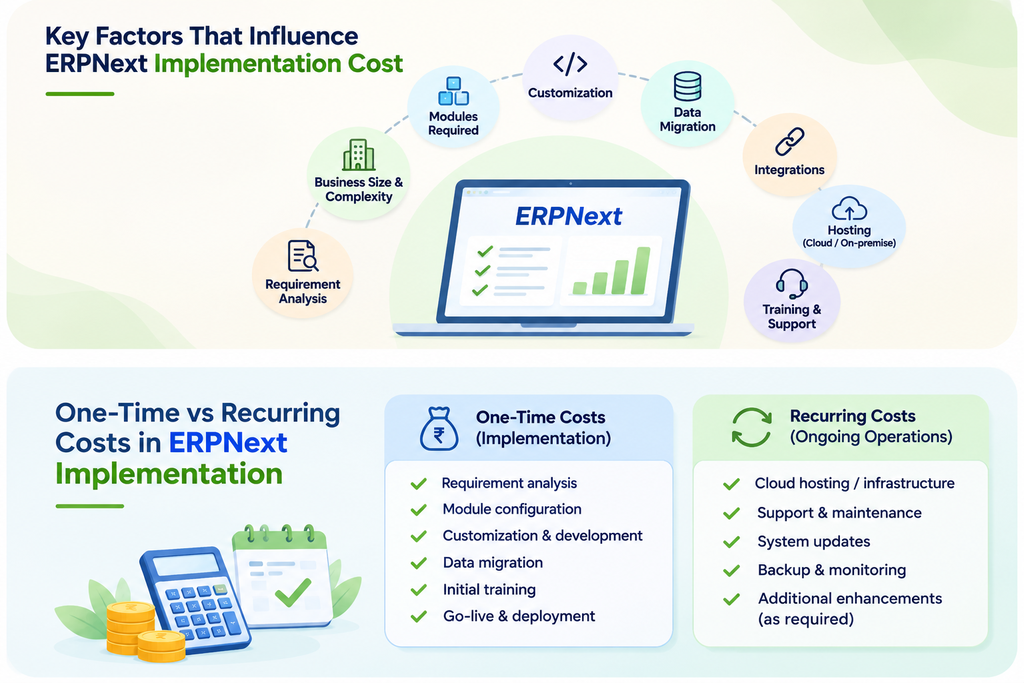
ERPNext Implementation: One-Time and Recurring Expenses
A useful way to prepare your budget is to separate initial project expenses from recurring operational expenses.
| Expense |
Cost type |
| Requirement analysis |
Initial |
| Module configuration |
Initial |
| Custom development |
Initial or ongoing |
| Data migration |
Initial |
| Third-party integration |
Initial or ongoing |
| Cloud hosting |
Recurring |
| Backup and monitoring |
Recurring |
| Support and maintenance |
Recurring |
| Employee training |
Initial or additional |
| Future enhancements |
As required |
This separation helps businesses understand the initial investment as well as the expenses involved in maintaining the system.
Example: ERPNext Implementation Requirements for Different Businesses
The implementation scope can vary significantly depending on the industry.
Example 1: Trading and Distribution Business
A trading company may need:
- Customer and supplier management
- Purchase orders
- Sales orders
- Stock management
- Warehouse operations
- Accounting and invoicing
Its implementation may focus on connecting procurement, inventory, sales and financial processes.
Example 2: Manufacturing Business
A manufacturing company may require:
- Raw material management
- Bills of Materials
- Work Orders
- Production planning
- Work-in-progress tracking
- Quality Inspection
- Finished goods management
- Custom production reports
This project may require more detailed process analysis, configuration, testing and employee training.
These examples demonstrate why implementation estimates should be based on the actual requirements of each business rather than a standard price per company or user.
How to Prepare an ERPNext Implementation Budget
Before requesting a quotation, prepare the following information.
Step 1: List Your Business Requirements
Identify the processes you want to manage through ERPNext.
For example, you may want to improve inventory tracking, manage procurement, organize accounting or monitor production.
Step 2: Identify the Required Modules
List the departments that will use ERPNext and identify the modules needed for their activities.
Prioritize essential requirements for the initial implementation.
Step 3: Document Customization Needs
Identify workflows, reports, approvals or integrations that may require additional development.
Explain each requirement using a practical business example.
Step 4: Review Your Existing Data
Identify where your current data is stored, how much information needs to be migrated and whether the records require cleaning.
Step 5: List Integration Requirements
Prepare a list of the external applications that must connect with ERPNext.
Step 6: Decide on Deployment
Evaluate cloud and on-premise options based on infrastructure, security, availability and maintenance requirements.
Step 7: Plan Training and Support
Discuss employee training, post-go-live assistance, maintenance and future enhancements.
Once these details are available, an implementation partner can assess the project scope and prepare a more relevant estimate.
Before requesting a proposal, use this guide: Before You Start ERPNext Implementation, Ask These 7 Questions.
How to Compare ERPNext Implementation Quotations
Receiving multiple quotations does not automatically make the lowest-priced proposal the best choice.
Compare the actual work included in each proposal.
| What to compare |
Questions to ask |
| Project scope |
Which modules and departments are included? |
| Configuration |
What standard ERPNext features will be configured? |
| Customization |
Which requirements need additional development? |
| Migration |
What data will be migrated and validated? |
| Integrations |
Which external applications are included? |
| Testing |
What testing and user acceptance activities are planned? |
| Training |
Which employees will receive training? |
| Support |
What assistance is available after go-live? |
A lower quotation may exclude activities such as data migration, integrations, employee training or ongoing support.
Review the deliverables, exclusions, responsibilities and payment milestones before making a decision.
How Tridots Tech Helps Businesses Plan ERPNext Implementation
Tridots Tech is a Frappe Gold Partner based in Chennai, India, providing ERPNext implementation and Frappe-related services.
A successful ERPNext project starts with understanding existing business processes, identifying requirements and deciding the right implementation scope.
Depending on the project, the work may involve:
- Business requirement analysis
- ERPNext module configuration
- Customization and application development
- Data migration
- Third-party integrations
- Cloud deployment
- Testing and user training
- Post-implementation support
The implementation approach should reflect the organization's operational requirements rather than follow the same configuration for every business.
If your company is evaluating ERPNext, explore Tridots Tech's ERPNext Implementation Services in India to discuss your requirements and project scope.
Planning an ERPNext Implementation?
Share your business requirements with Tridots Tech to discuss the modules, customization, migration and deployment approach suitable for your organization.
Contact Tridots Tech to discuss your ERPNext project.
Frequently Asked Questions About ERPNext Implementation Cost
1. How much does ERPNext implementation cost in India?
There is no universal fixed price for ERPNext implementation. The cost depends on modules, business complexity, customization, data migration, integrations, hosting, training and support. A project-specific estimate is more reliable than a generic price range.
2. Is ERPNext free to use?
ERPNext is open-source software. However, businesses may still incur expenses for implementation, customization, hosting, infrastructure, integrations, training and ongoing support.
3. Does the number of users affect ERPNext implementation cost?
The number of users can influence access configuration, training and infrastructure requirements. However, the total cost also depends on business processes, project scope and technical requirements.
4. Does ERPNext customization increase implementation cost?
Customization can increase implementation effort because it may require requirement analysis, development, testing and maintenance. Businesses should first check whether standard ERPNext features and configuration can meet their needs.
5. What is included in ERPNext implementation services?
Implementation services may include requirement analysis, module configuration, customization, data migration, integrations, testing, deployment and user training. The exact scope depends on the implementation agreement.
6. Is ERPNext cloud hosting included in implementation?
Not necessarily. Hosting may be provided separately or included in a service package. Businesses should confirm server resources, backups, monitoring, maintenance and support arrangements.
7. How long does ERPNext implementation take?
The timeline depends on the number of modules, business complexity, data readiness, customization, integrations and testing requirements. A realistic timeline should be prepared after requirement analysis.
8. How can a business reduce ERPNext implementation expenses?
Businesses can manage implementation expenses by defining requirements clearly, prioritizing essential modules, preparing clean data, avoiding unnecessary customization and planning employee training early.
Final Thoughts
ERPNext implementation cost in India depends on how the system needs to support your business operations.
Modules, customization, data migration, integrations, infrastructure, training and ongoing support all contribute to the overall investment.
Before choosing an implementation partner, understand the proposed project scope and compare the actual deliverables rather than relying only on the quoted price.
A well-prepared implementation budget helps your business plan the project, allocate resources and move towards ERPNext with clearer expectations.